
The build vs buy software decision is defined as the choice between commissioning custom software built to your exact workflows and purchasing an off-the-shelf product that works out of the box. For small business owners in Nottinghamshire and across the UK, this choice shapes your costs, your competitive edge, and how much control you have over your own operations for years to come. The right answer depends on three things: how much your software needs to differentiate your business, what resources you can realistically commit, and how well you understand the true total cost of each path. Neither option is universally better. Both carry risks that most guides quietly skip over.
What are the real costs and trade-offs of building vs buying software?
The total cost of ownership is routinely underestimated by two to three times for both building and buying. That figure covers cloud hosting, maintenance, integration, implementation, training, and ongoing charges. Most business owners budget for the licence fee or the developer quote and forget everything else.
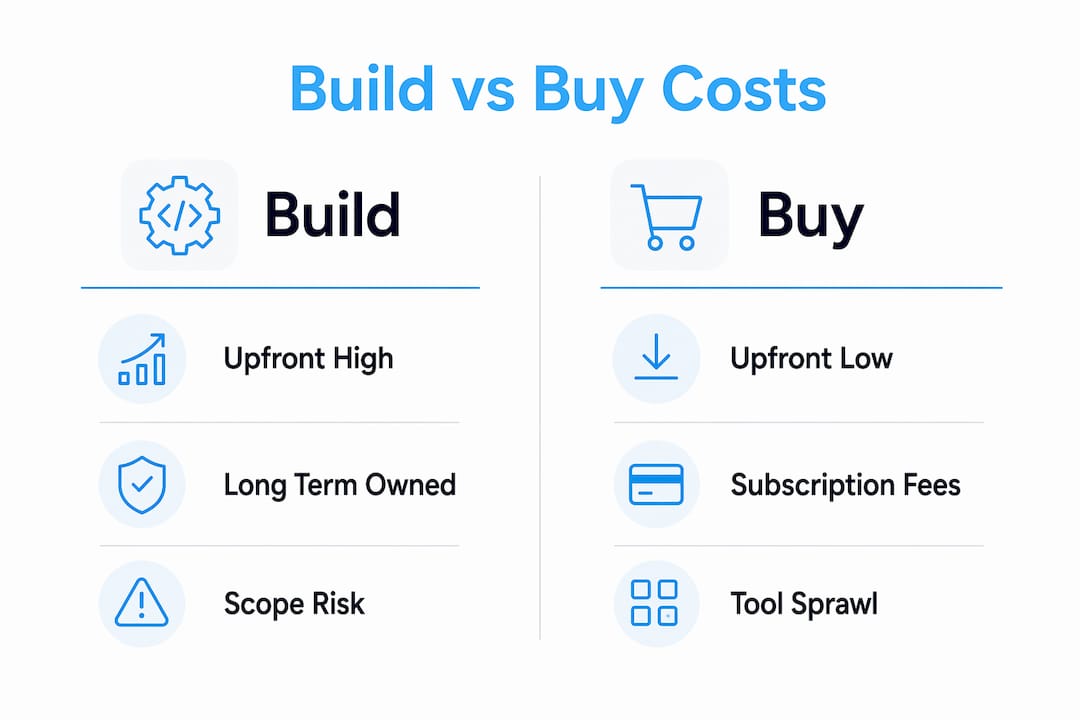
Buying off-the-shelf software looks cheaper on day one. A SaaS subscription might cost a few hundred pounds a month versus tens of thousands for a custom build. The problem is that subscription costs compound. In 2026, SaaS vendors are applying a 20–37% AI tax uplift on renewals for AI-inclusive plans. That means a platform you budgeted at £500 per month could renew at £650 or more, with no meaningful opt-out.

Custom software development carries a higher upfront cost but a predictable long-term one. Once built, you own it. There are no renewal surprises, no vendor deciding to double your tier. The break-even point typically falls somewhere in the 18–36 month range, depending on complexity and team size. After that, a custom build is almost always cheaper per year than a comparable SaaS stack.
Pro Tip: Before you commit to either path, model your costs over three years, not one. Include integration work, staff training, and a 25% contingency for scope changes. The three-year view almost always changes the decision.
The hidden costs on the buy side
Buying software creates a different kind of cost problem: tool sprawl. Firms with fewer than 500 employees now average more than 100 SaaS applications in active use. Each tool needs connecting to the others, and those integrations cost money, time, and ongoing maintenance. Data fragmentation is the silent consequence. Your customer records live in one system, your invoices in another, and your project notes in a third. Pulling a coherent picture of your business requires either expensive middleware or someone doing it manually.
The hidden costs on the build side
Custom builds carry their own traps. Scope creep is the most common. A project that starts as a simple job-management tool grows to include invoicing, reporting, and a customer portal before anyone has agreed a budget for those additions. Maintenance is also a permanent commitment. You will need someone to update dependencies, fix bugs, and handle security patches. If your developer moves on, that knowledge walks out with them.
| Cost factor | Build (custom) | Buy (off-the-shelf) |
|---|---|---|
| Upfront investment | High | Low to medium |
| Monthly ongoing cost | Low after build | Medium to high, rising with AI tax |
| Integration complexity | Moderate (you control it) | High (multiple SaaS tools) |
| Maintenance responsibility | Yours | Vendor’s |
| Long-term flexibility | Full | Limited by vendor roadmap |
How has AI changed the build or buy software decision in 2026?
AI-assisted development has genuinely shifted the maths. Tools like Claude Code and Cursor now cut internal development effort by 60–80%, reducing build estimates from twelve weeks to two to four weeks for experienced teams. That is not a marginal improvement. It changes the break-even calculation entirely and makes building a realistic option for businesses that would have dismissed it three years ago.
The practical implication is significant. A custom CRM or booking system that once required six months and a five-figure budget can now be prototyped in weeks. That speed advantage used to belong exclusively to buying. AI has redistributed it.
The rise of hybrid buy-and-extend models is the direct result. Businesses buy a commodity platform for payroll, HR, or basic ticketing, then build custom workflows on top via APIs or low-code tools. This approach combines the speed of buying with the control of building. It is the option most guides overlook entirely.
-
AI coding tools reduce development time dramatically, making custom builds viable for smaller budgets.
-
Hybrid models let you buy the generic parts and build only what makes your business different.
-
Vendor pricing volatility in 2026 means the cost advantage of buying is shrinking year-on-year.
-
Vendor risk, including acquisition, pricing shifts, and roadmap changes, must now be explicitly scored in any buying decision.
Pro Tip: If you are considering a custom build, ask your developer or agency to show you a working prototype within four weeks. If they cannot, that is a warning sign about delivery capability.
What decision framework should you use to choose between building or buying?
The most reliable method is a scoring matrix across ten criteria. Score each criterion from one to five for your specific situation, then total the scores. A high score leans toward building; a low score leans toward buying.
-
Competitive differentiation. Does this software directly affect how you win or retain customers? If yes, score high for build.
-
Customisation depth. Do you need more than 30% of the functionality to work differently from the standard product? Score high for build.
-
Integration requirements. Do you need to connect with five or more existing systems? Score high for build.
-
Regulatory demands. Does the software need to meet specific compliance requirements your vendor cannot certify? Score high for build.
-
Time to market. Do you need this live within eight weeks? Score high for buy.
-
Engineering capacity. Do you have a reliable development team or agency ready to start? Score high for build.
-
Budget certainty. Is your budget fixed with no tolerance for overrun? Score high for buy.
-
Vendor maturity. Does a mature, compliant vendor product already exist for this function? Score high for buy.
-
Data ownership. Is it critical that you own and control all your data? Score high for build.
-
Long-term cost tolerance. Can you absorb rising subscription costs over three to five years? Score low for buy.
Scores of 35 and above lean toward building or a hybrid approach. Scores below 25 lean toward buying. The middle ground, 25–34, is where the hybrid buy-and-extend model usually wins.
Run this as a decision sprint: gather your key stakeholders for two hours, score each criterion independently, then compare. Disagreements on individual scores reveal assumptions worth examining before you commit.
What are the common pitfalls and how do you avoid them?
Custom builds fail in predictable ways. The most common is shipping nothing usable within the first three months. Internal builds that do not deliver a working version within 90 days almost always stall permanently. Scope creep, leadership changes, and shifting priorities kill momentum. The fix is simple in theory: agree four-week milestones before development starts, and treat a missed milestone as a formal decision point, not just a delay.
Governance is the other failure mode. Many AI-assisted projects collapse not because the code is wrong but because specification discipline and security review were skipped in the rush to build fast. Write your requirements before you write your first line of code.
On the buy side, the risks are subtler but equally damaging:
-
Integration costs are rarely budgeted. Connecting a new SaaS tool to your existing systems can cost as much as the annual licence.
-
Vendor lock-in makes switching painful. Your data, your workflows, and your staff training are all tied to a platform that can change its pricing or terms at any time.
-
AI tax creep means your subscription costs will rise faster than inflation in 2026 and beyond.
-
Roadmap misalignment is when the vendor builds features for their largest customers, not for you. The tool stops fitting your needs, but switching costs keep you trapped.
Pro Tip: Run a pilot project before committing to a full build. Spend four weeks building one core workflow. If the team delivers it cleanly, you have evidence the full project is viable. If they struggle, you have saved yourself a much larger loss.
Key takeaways
The build vs buy software decision requires a three-year cost model, a clear view of your competitive differentiation needs, and an honest assessment of your delivery capability before you commit to either path.
| Point | Details |
|---|---|
| Model costs over three years | Total cost of ownership is underestimated by two to three times; include integration, training, and maintenance. |
| Factor in the AI tax | SaaS renewals carry a 20–37% AI uplift in 2026; buying is less predictable than it appears. |
| Consider the hybrid model | Buy commodity functions and build only what differentiates your business to cut Year 1 costs. |
| Ship within 90 days or restructure | Custom builds that miss the 90-day usable version milestone rarely recover; set four-week milestones. |
| Score vendor risk explicitly | Pricing volatility, acquisition risk, and roadmap changes must be weighted in any buying decision. |
What I have actually seen working with small businesses on this decision
Having worked with small business owners across the East Midlands on software decisions, the pattern I see most often is this: owners underestimate how much a SaaS stack costs them over time, and overestimate how much a custom build will cost them upfront.
The hybrid model is genuinely underused. Most businesses I speak to have never considered buying a base platform and extending it with custom code. They think it is all or nothing. It rarely is. A well-chosen base platform with a few thousand pounds of custom development on top often outperforms both a full custom build and a sprawling SaaS stack.
My honest warning on full custom builds: do not start one without a delivery team you trust completely. AI tools have made building faster, but they have not made it foolproof. The projects I have seen fail were not failed because of bad code. They failed because nobody owned the specification, nobody enforced the milestones, and nobody asked the hard questions early enough.
The subscription trap is real. I have watched businesses pay for tools they barely use because switching feels too painful. That is not a technology problem. That is a decision made too quickly without a three-year cost model. Take the time to do the maths properly before you sign anything.
— Chris
How Ttoydigital can help you make the right call
Choosing between building and buying is genuinely difficult, and the wrong call costs real money. At Ttoydigital, we work with small businesses across Nottinghamshire to cut through the noise and make this decision clearly.
We help you run the scoring matrix, model your three-year costs, and identify whether a custom build, an off-the-shelf product, or a hybrid approach fits your situation. If building is the right answer, our team can take you from specification to working software with clear milestones and no surprises. Visit Ttoydigital to find out how we approach custom software decisions for businesses like yours, and get a straight conversation about what actually makes sense for your budget and goals.
FAQ
What is the build vs buy software decision?
The build vs buy software decision is the choice between commissioning custom-built software and purchasing an existing off-the-shelf product. The right answer depends on your differentiation needs, budget, and delivery capability.
How long does it take for a custom build to break even against buying?
The break-even point for custom software development typically falls within 18–36 months compared to equivalent SaaS subscription costs. After that point, a custom build is generally cheaper per year.
What is the AI tax on SaaS software?
The AI tax is the 20–37% subscription uplift that SaaS vendors are applying to AI-inclusive renewal plans in 2026. It raises the long-term cost of buying off-the-shelf software significantly.
When should a small business choose buying over building?
Buying is the better choice when a mature, compliant vendor product already exists, when you need to go live within eight weeks, or when your engineering capacity is limited. Payroll and ticketing are classic examples where buying wins.
What is the hybrid buy-and-extend model?
The hybrid model means buying a commodity platform for standard functions and building custom workflows on top via APIs or low-code tools. It reduces Year 1 costs by 30–40% compared to a full custom build while preserving control over your unique processes.
Related reading: Best small business CRM for UK firms · Pipedrive vs HubSpot: which CRM suits UK SMEs?