
Which CRM is right for your UK business: Pipedrive or HubSpot?
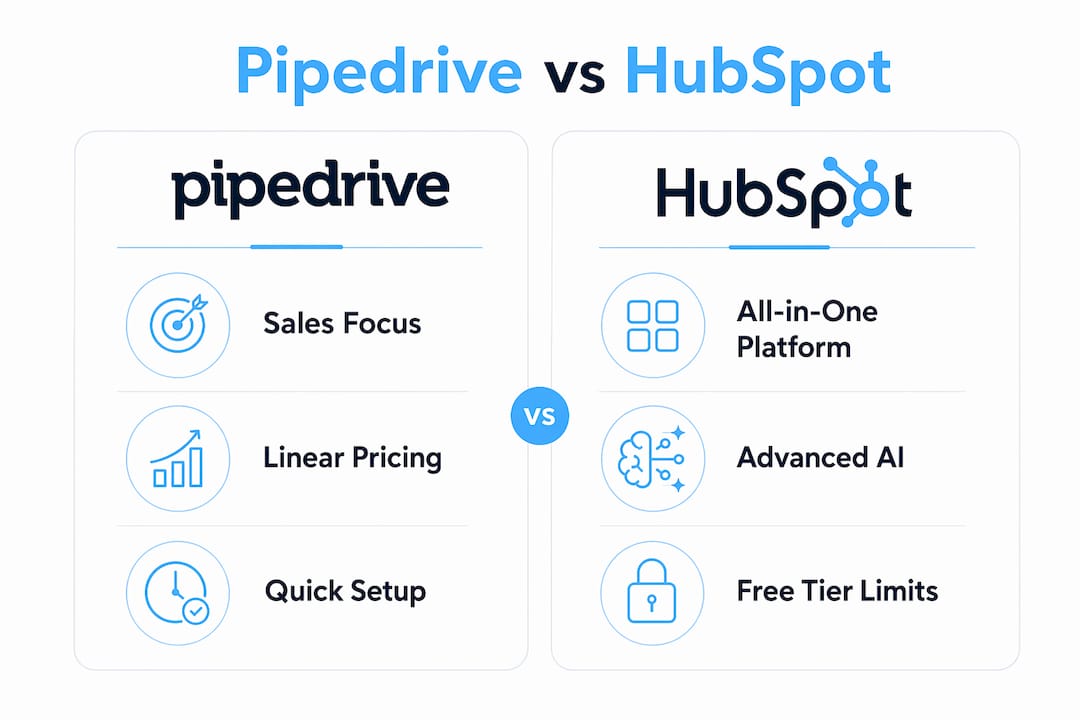
If your team’s primary job is closing deals, Pipedrive wins on simplicity, adoption speed, and predictable cost. If marketing, sales, and service all share the same customer record, HubSpot earns its higher price tag. That single question, whether marketing genuinely shares the CRM, resolves most of the Pipedrive vs HubSpot decision before you even open a pricing page.
| Dimension | HubSpot | Pipedrive | Best fit |
|---|---|---|---|
| Features | Marketing, sales, service, content, data hubs | Sales pipeline, deal management, AI Pulse | HubSpot for full GTM; Pipedrive for sales-only |
| Pricing | Free tier (limited); paid from ~$14/user/mo | From ~$14/user/mo; no onboarding fees | Pipedrive for predictable budgets |
| Ease of use | 8.7 on G2 | 8.9 on G2 | Pipedrive for fast onboarding |
| AI capabilities | Breeze AI across all hubs | Pulse (pipeline prioritisation, beta) | HubSpot for breadth |
| Best fit by team | Marketing + sales + service teams | Sales-focused teams under about 10 reps | Depends on team structure |
Key differences worth knowing before you go deeper:
- Pipedrive’s per-user pricing scales linearly with no surprise onboarding fees; HubSpot’s Professional plan carries mandatory onboarding costs.
- HubSpot’s free CRM now has significant limits on contacts and users, reducing its usefulness for growing teams compared to before.
- G2 users rate Pipedrive’s pipeline management at 8.9 versus HubSpot’s 8.7, while HubSpot leads on email marketing at 8.8 versus Pipedrive’s 7.4.
- Both platforms have verified UK business presences, giving English buyers local support access.
How do the core features actually compare?
Pipedrive is built around one idea: make the pipeline visible and keep reps moving. Its drag-and-drop board shows every deal’s stage at a glance, and the activity-based model means reps update it because it’s fast, not because someone told them to. G2 users give its opportunity and pipeline management a score of 8.9, compared to HubSpot’s 8.7 in the same category.

HubSpot’s sales CRM is genuinely good, but it sits inside a much larger platform with advanced CMS SEO Automation capabilities. That breadth is the point if you need it. Marketing automation scores 8.8 on G2 versus Pipedrive’s 7.4, and the email marketing gap is equally wide. HubSpot’s Conversations inbox lets every sales agent see incoming queries from email and live chat in one shared view, which Pipedrive simply doesn’t replicate natively.
On automation, HubSpot’s Breeze AI spans marketing, sales, and service, handling prospecting, content, and reporting from plain-English prompts. Pipedrive’s AI centres on Pulse, a feed that prioritises next steps based on deal strength and sales interactions. Pulse also includes data enrichment and custom deal scoring, though it remains in beta. If you need AI that touches every department, HubSpot pulls ahead by design.
Contact management is where HubSpot can frustrate. It doesn’t cleanly differentiate between contacts, leads, and companies, which adds friction for teams with tidy data habits. Pipedrive handles this more intuitively, and its proposal generation features are stronger out of the box.
What does pricing actually look like for UK teams?
This is where the two platforms diverge most sharply. Pipedrive’s pricing is straightforward with linear per-user costs and no hidden fees. All plans include unlimited contacts, so you won’t get a nasty bill when your database grows.

HubSpot’s pricing includes a free CRM with user and contact limits, and paid plans with escalating costs and mandatory onboarding fees, along with additional costs as your database grows.
For a sales-only team of about ten people, Pipedrive generally offers predictable, modest monthly costs, while HubSpot’s total costs can be significantly higher once onboarding and database size are considered. The free tier lures you in, and then the Professional jump is steep.
Pro Tip: Model the three-year total cost, including onboarding fees and projected contact growth, not just the monthly per-seat rate. That single exercise changes the outcome for most UK SMEs comparing these two platforms.
Which platform is easier to set up and use?
Pipedrive’s simpler onboarding and sales-native interface mean small sales teams reach productive use quickly. For teams under about ten people focused on closing deals, it’s usually the better starting point. Basic setup can take a day or two, and the learning curve is shallow enough that reps adopt it without being pushed.
HubSpot is also known for a relatively intuitive interface compared to enterprise tools, and it drives strong adoption when the whole go-to-market team is on it. The problem is that a pure sales team often finds it heavier than it needs. There are far more menu options, settings, and hubs to navigate, and getting the most from reporting requires real investment in setup time.
Two-way email syncing is worth flagging. HubSpot connects to Gmail and Outlook on its free plan. Pipedrive reserves two-way syncing for Advanced plan users, though you can connect any email client from the start.
How do you choose between Pipedrive and HubSpot?
The decision for UK SMEs comes down to three honest questions.
- What is your primary need? Sales pipeline management, deal tracking, and rep productivity point to Pipedrive. Connecting marketing to sales to service on one record points to HubSpot.
- Does marketing genuinely share the CRM? If marketing runs its own tools and sales just needs a pipeline, HubSpot’s breadth is overhead. If lead scoring, nurturing, and attribution flow into the same system your sales team lives in, the suite earns its cost.
- What is your budget over three years? Pipedrive’s linear pricing rarely surprises you. HubSpot’s free tier is an effective funnel into a much larger spend once you need real pipeline features.
If you’re a solo trader or a small team that just needs to stop using spreadsheets, HubSpot’s free CRM is a perfectly reasonable starting point. The moment you need real automation or pipeline features, the price jumps. Pipedrive’s entry-level plan at around $14 per user per month gives you a fully functional sales CRM without contact limits from day one.
How long does implementation take, and what about migration?
Pipedrive is known for quick setup, often a day or two for basic use. HubSpot takes longer depending on data complexity, and getting advanced features like forecasting and AI prospecting running properly requires meaningful configuration time.
Migration is where both platforms demand care. Moving basic contact and deal data between them is generally manageable, but preserving historical emails, call logs, notes, and custom fields requires careful planning. Switching to HubSpot at Professional or Enterprise tier also means paying those mandatory onboarding fees on top of the migration effort. Switching from HubSpot to Pipedrive tends to be less complex on the data side, but still involves training, integration rework, and data cleaning.
UK market context: GDPR, AI trends, and integration depth
Both platforms include GDPR compliance features relevant to UK businesses, covering data access controls, consent management, and audit trails. Neither requires a separate compliance layer for standard UK data handling.
On AI, the gap is widening. HubSpot’s Breeze AI now covers prospecting, content generation, reporting, and customer service, touching every hub. Pipedrive’s Pulse is focused and useful for sales prioritisation, but it covers a narrower slice of the workflow and remains in beta. For teams thinking about where AI will take their processes over the next two to three years, HubSpot’s investment is broader.
Integration depth matters too. HubSpot connects natively with over 2,000 apps and its Data Hub enables bi-directional sync. Pipedrive offers 500-plus integrations, which suits a best-of-breed stack built around a focused sales core. If your existing tools include a dedicated marketing platform, Pipedrive slots in cleanly alongside them. If you want everything talking to everything natively, HubSpot’s ecosystem is the stronger fit.
TTOY Digital’s SmartFlowCRM: a different route for small businesses
If you’ve read this far and you’re thinking “both of these feel like more than we actually need,” you’re not alone. Many small businesses we speak with don’t need a full enterprise CRM. They need leads to stop falling through the cracks.
TTOY Digital’s SmartFlowCRM brings WhatsApp, email, and other channels into one place, so you can manage leads without juggling five tabs. It’s built specifically for small businesses, set up by us, and supported by a team that actually picks up the phone. No mandatory onboarding fees, no contact-tier pricing surprises. If you’d rather have a CRM that fits your business today and grows with you, get in touch with TTOY Digital to see how it works in practice.
Key takeaways
Pipedrive suits sales-focused UK SMEs best; HubSpot suits teams where marketing, sales, and service genuinely share one customer record.
| Point | Details |
|---|---|
| Sales-only teams | Pipedrive’s visual pipeline and linear pricing make it the stronger fit for teams under ~30 reps. |
| All-in-one needs | HubSpot connects marketing, sales, and service on one record, justifying its higher cost when all three are active. |
| Pricing transparency | Pipedrive runs from ~$14/user/month with no onboarding fees; HubSpot’s Professional plan adds mandatory onboarding costs. |
| AI capabilities | HubSpot’s Breeze AI spans every hub; Pipedrive’s Pulse focuses on pipeline prioritisation and remains in beta. |
| TTOY Digital option | For small businesses wanting a simpler, supported CRM setup, TTOY Digital’s SmartFlowCRM integrates WhatsApp and email without enterprise-level complexity. |
FAQ
Is HubSpot better than Pipedrive?
Neither is universally better. HubSpot is the stronger choice when marketing, sales, and service share one platform; Pipedrive wins for sales-focused teams that want a clear pipeline, fast onboarding, and predictable costs.
What are the disadvantages of Pipedrive?
Pipedrive lacks native marketing automation and deep customer service features, so teams needing campaign analytics or lead nurturing alongside sales will require additional integrations or a separate tool.
Who is HubSpot’s biggest competitor?
Salesforce is HubSpot’s most direct enterprise competitor, but for UK SMEs comparing all-in-one platforms, Pipedrive is the most commonly considered alternative at the sales CRM level.
Why is HubSpot falling out of favour with some small teams?
HubSpot’s recent free CRM changes reduced user and contact limits, making the free tier far less useful for growing teams and pushing more businesses to evaluate Pipedrive’s paid plans instead.
Related reading: Best small business CRM for UK firms · Build vs buy software: the 2026 guide