
Lead response time is the gap between a prospect getting in touch and a real person sending them something useful. For a small business the practical answer is this: acknowledge fast, reply properly the same working day, and measure it every week so a missed enquiry never goes unnoticed. The work is less about heroic speed and more about having one place where every enquiry lands, one person who owns it and one number you actually look at. That is the idea behind how we set up SmartFlowCRM, which brings WhatsApp, email and other channels into a single platform.
TL;DR
- Lead response time runs from the moment the enquiry arrives to the first human reply that answers something. An automatic “thanks for your message” does not stop the clock.
- The famous five-minute rule comes from US sales teams phoning web leads. For a UK trade, clinic or agency, aim for a near-instant acknowledgement and a proper reply the same working day.
- UK mystery-shopping research found many firms replied late or not at all, so a consistent reply is a real edge.
- Measure the median, the slowest tenth and the number of unanswered leads. Never count an unanswered lead as zero.
- Put every channel into one inbox or CRM, give each enquiry an owner, and review it weekly.
Table of Contents
- What lead response time actually means
- What the research says (and what it doesn’t)
- Is five minutes the right target for you?
- How to measure it properly
- How to reply faster without sending worse replies
- Where your website comes in
- Perspective: why this is an organising problem
- Getting started this week
- FAQ
- Sources
What lead response time actually means
A lead is anyone who asks for something: a contact form, a call, an email, a WhatsApp message, a quote request. Lead response time is how long they wait before a person comes back to them.
Two details trip people up.
The clock starts when the enquiry arrives, not when somebody opens it. If a form goes in at 6.40pm on Friday and you read it at 9am on Monday, the customer waited those hours, whatever your inbox says.
The clock stops at a human reply that moves things forward. That means answering the question, or asking for the one missing detail, and offering a next step. A receipt email that says “we’ll be in touch” is useful, but it is an acknowledgement, not a response. Track it separately.
Why stop at the first reply and not at the quote? Because people form a view early. By the time a quote lands on day four, the customer has already half-decided whether you are the sort of firm that comes back to people. A good quote cannot fully repair a slow first impression.
What the research says (and what it doesn’t)
Most of what you will read online traces back to a handful of studies. They are useful, but you should know what each one measured.
The classic figures
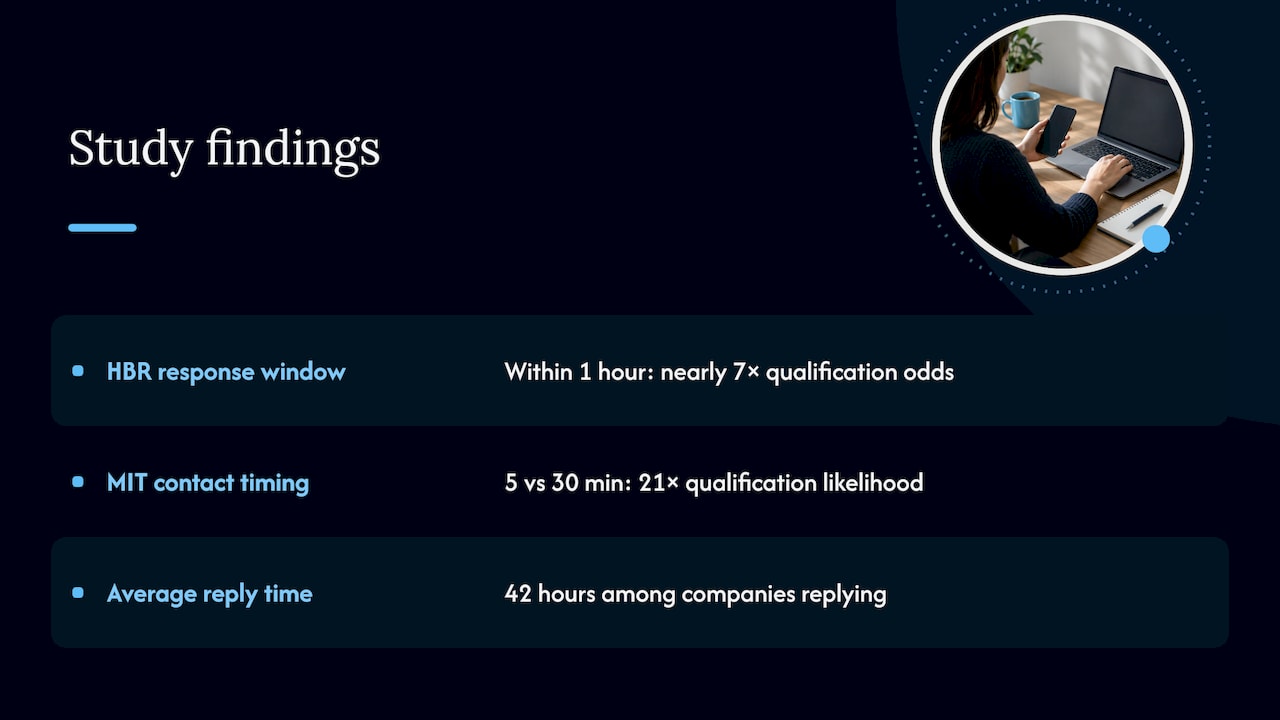
The 2011 Harvard Business Review analysis, The Short Life of Online Sales Leads, examined how companies handled online enquiries. It found that firms attempting contact within an hour were nearly seven times as likely to qualify the lead as those waiting even one hour longer. In the same research, the average company that replied at all took 42 hours.
The often-quoted five-minute rule comes from a 2007 study led by Dr James Oldroyd at MIT Sloan with a sales-software company. It found a business was 21 times more likely to qualify a lead contacted within five minutes than one contacted after 30 minutes. It measured outbound phone calls to US business-to-business web leads, so those multipliers should not be laid directly over a plumber, a dental practice or a three-person design studio answering email.
Both studies are also old, from before everyone carried a smartphone. Treat them as proof of direction, not a precise promise. Speed matters, and delay costs you, but the exact multiplier for your business is unknown.
What UK firms actually do
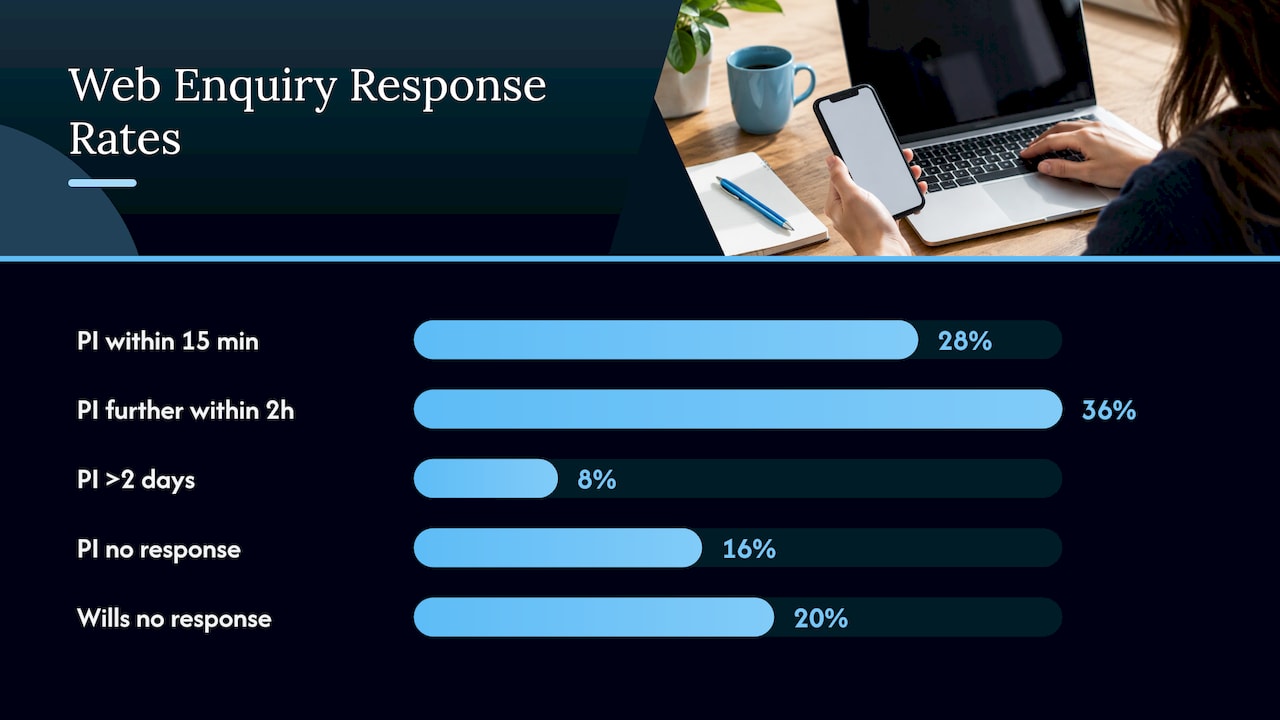
The more useful evidence for a UK owner is closer to home. In its 2023 mystery-shopping white paper, First4Lawyers had 100 law firms tested by phone and website. For personal injury web enquiries, 28% of shoppers got a non-automated response within 15 minutes and a further 36% within two hours. But 8% waited more than two days and 16% heard nothing at all. For wills web enquiries, 20% received no response, and none of the firms called back inside 15 minutes.
Legal Futures’ report on the same research notes that as many as one in five enquiries went unanswered, and that firms handled personal injury and wills enquiries differently, which suggests service standards were not applied consistently.
The white paper also makes a point every owner should remember: when shoppers did speak to a firm they were broadly happy (88% described the treatment as warm and engaging for personal injury web enquiries), but their overall rating was dragged down by how long the callback took. The conversation was fine. The wait was the problem.
These are law firms, but the pattern is familiar to any small business: the enquiry arrives, gets lost between a phone, an inbox and a social message, and nobody picks it up. If most of your competitors behave this way, a dependable same-day reply puts you ahead of them without any heroics.
Is five minutes the right target for you?
For a sales team with dialling software and people sitting at desks, perhaps. For a sole trader on a roof, a therapist in a session or a café owner mid-service, a five-minute promise is one you will break by Tuesday, and a target nobody can hit tends to get abandoned rather than approximated.
A version that survives a real working week has two tiers:
- Acknowledge almost instantly. This is worth automating. A short message confirming you have the enquiry and when to expect a proper reply.
- Reply properly within a stated window. For most small businesses, the same working day. Faster for high-value, time-sensitive work such as emergency call-outs, urgent bookings or valuations.
Write the window down and keep it realistic. “Within two working hours, 9 to 5, Monday to Friday” that you hit 95% of the time beats “within five minutes” that you hit 30% of the time.
One caution on automation: an instant acknowledgement should not claim a person has reviewed the request. Keep it honest, for instance by saying you have received it and a named person will reply by a stated time. It also should not be counted as your response time, or your numbers will look better than your customers’ experience.
How to measure it properly
You do not need a data team. You need a spreadsheet or your CRM and a clear rule. Here is a routine that works.
Step 1: choose a start and a stop
- Start: the time the enquiry reached you (the form submission, the email arrival, the message received), kept even if the lead is later reassigned.
- Stop: the time a person answered the question or asked for the missing detail.
The formula is simply the first human reply time minus the enquiry received time.
Step 2: decide your clock
Elapsed time counts every hour. Business-hours time counts only the hours you are open. Report both, because they tell different stories. Take a Friday 5.55pm enquiry answered on Monday at 9.05am. That is 63 hours 10 minutes elapsed, but only 10 minutes of staffed time. The second number says your team was quick when open. The first says the customer waited the whole weekend. Both are true, and the customer feels the first one.
State your calendar in plain terms: Monday to Friday, 9am to 5pm, UK time, bank holidays excluded.
Step 3: use the median and the slow tail, not just the average
A single enquiry that sits for nine days wrecks an average. Instead report:
- Median: the middle value when you sort all the response times. Half your leads were answered faster than this.
- 90th percentile: the response time that nine in ten leads beat. It shows how bad your slow days are.
- Unanswered count and age of the oldest: the number nobody has replied to yet, and how long the longest has waited.
Here is a worked example. You receive ten enquiries in a week. Eight are answered, in 12, 20, 25, 40, 55, 90, 180 and 300 minutes. Two are unanswered, one for three days.
| Measure | Result |
|---|---|
| Leads received | 10 |
| Leads answered | 8 |
| Response coverage (answered ÷ all) | 80% |
| Median of answered | 47.5 minutes |
| Slowest tenth (90th percentile, rank 8 of 8) | 300 minutes |
| Unanswered | 2, oldest waiting 3 days |
The median looks healthy. The coverage figure is the one to worry about. Never record an unanswered lead as zero minutes or quietly leave it out, because that makes the worst performance look like the best.
Step 4: review weekly
Ten minutes every Monday: how many came in, how many were answered, what was the median, what is still waiting. Anything unanswered gets a reply that day.
How to reply faster without sending worse replies
Speed without substance irritates people. The aim is a reply that is quick and also useful. This is the routine we would put in place for most small businesses.
1. Bring every channel into one place
The commonest reason for slow replies is not laziness. It is scatter. A web form goes to one mailbox, calls go to a mobile, WhatsApp goes to someone’s personal phone, and an enquiry sits unseen. Route forms, calls, email and messages into one shared inbox or CRM (customer relationship management system, the tool that keeps every contact and conversation in one record).
This is exactly what SmartFlowCRM is for: it integrates communication channels such as WhatsApp and email into one platform, so lead management happens in one view rather than five. Our CRM plans are Silver at £130 per month and Gold at £260 per month.
2. Give every enquiry one owner
If two people can answer an enquiry, each assumes the other has. Name one owner per lead, and a backup for holidays and sick days. Ownership turns “somebody should reply” into “Priya replies by 11”.
3. Send an honest automatic receipt
A short note that confirms receipt, says when a person will reply and, if it fits, offers a phone number for anything urgent. Our guide to marketing automation for small businesses covers where automation helps and where a human should step in.
4. Make the first human reply do real work
A good first reply is short and does four things:
- thanks them by name,
- answers their main question,
- asks for one missing detail if you need it,
- offers a clear next step, such as a call slot or a site visit.
Compare “Thanks for your enquiry, we’ll be in touch” with “Hi Sam, yes, we cover Chesterfield. A bathroom of that size usually takes about a week. Can you send a photo of the space? I can visit Thursday or Friday.” The second is a response. The first is a receipt.
5. Sort the urgent from the routine
Not every lead deserves the same speed. A burst pipe, a same-week booking or a high-value quote request should jump the queue. A general question about services can wait until the afternoon. A simple scoring rule helps you decide, and our guides to lead scoring for small B2B teams and lead qualification frameworks show how to do it without enterprise-sized complexity.
6. Cover the gaps
Evenings and weekends are where leads leak. If you cannot reply outside working hours, say so in your acknowledgement and promise a first-thing reply. Customers are far more forgiving of a stated delay than of silence.
Where your website comes in
Fast replies depend on a website that makes enquiring easy and captures the right detail at the start. A short form that asks for the job type, location and best contact method saves a round of questions. A visible phone number and WhatsApp option on mobile helps people who would rather not fill in a form. Most of your visitors will arrive on a phone, so the enquiry route has to work with a thumb.
If your current site is not producing enquiries in a form you can act on, our web design plans start at £120 per month (Starter), with Growth at £170 and Smart at £560 per month. And if more of your leads are to come from Google, our local SEO service is from £150 per month.
Perspective: why this is an organising problem
We talk to small business owners who say they are pulling their hair out over leads. They are not careless. They are running a business, and the enquiry arrives on a Friday evening via a form, a missed call and a WhatsApp message, and nobody sees all three.
What we have found sensible is to stop thinking of lead response as a speed contest and treat it as a manual bottleneck to remove. Get every channel into one place. Give each enquiry an owner. Decide a reply window you can really keep. Then look at the numbers weekly. None of that needs a sales department.
That is why SmartFlowCRM exists. It brings WhatsApp, email and other channels into one platform so lead management is not a juggling act, and because our team is based in Derbyshire we can sit down with you in person and set it up around how your business actually works, not around a template.
Chris
Getting started this week
You can improve your lead response time in a week without buying anything:
- List every place an enquiry can land (forms, phone, email, WhatsApp, social messages, directory listings).
- Choose a reply window you can hit nine times out of ten.
- Write the honest acknowledgement and the template for a good first reply.
- Name an owner and a backup.
- Start a simple log: received time, first human reply time, status.
- Review it next Monday.
When the log shows leads slipping between channels, that is the moment to move to a single platform. If you would like to talk it through, our CRM service page has the plans and the details of what SmartFlowCRM does.
FAQ
What is a good lead response time?
For high-intent enquiries, as fast as you can sensibly manage, with minutes being the research-backed ideal for phoned web leads. For most small businesses, a near-instant acknowledgement plus a proper human reply within the same working day is a target you can keep. Choose one you will hit consistently and write it down.
What does response time mean for a lead?
It is the time between the lead getting in touch and a person giving a useful first reply. The clock starts when the enquiry arrives and stops when someone answers the question or asks for the missing detail. An automatic receipt does not count.
How do I calculate lead response time?
Subtract the time the enquiry arrived from the time of the first human reply. Do that for every answered lead, then report the median and the 90th percentile. Keep unanswered leads in your count of leads received, with the age of the oldest one, rather than treating them as zero.
Does the five-minute rule apply to a small UK business?
It is a real finding, but it was measured on US sales teams phoning web leads. Use it as a reminder that waiting costs you, not as a target you must hit on every channel. A dependable same-day reply, plus fast acknowledgement, is realistic for most owners.
Sources
- The Short Life of Online Sales Leads, Harvard Business Review
- From first impressions to follow-up calls, First4Lawyers white paper 2023
- Law firms failing to respond to consumer enquiries, Legal Futures
Recommended
- Lead Qualification Frameworks: Which One Suits a Small Business?
- Lead Scoring for Small B2B Teams: Rules First, Predictive Later
- Six Email Nurture for Small Businesses That Uses Behaviour Triggers
- Keap vs HubSpot: which CRM suits UK small businesses?
Related reading: Pipedrive vs HubSpot: which CRM suits UK SMEs? · Local SEO checklist for small businesses