Here is the short version: claim and complete your Google Business Profile (GBP), make your name, address and phone number (NAP) identical everywhere it appears online, collect reviews consistently, and publish at least two location-specific pages on your website. Do those four things well and you will outrank most local competitors who have not. Practitioner experience suggests roughly 80% of local SEO outcomes come from five core elements: GBP, reviews, NAP consistency, on-page optimisation, and local content. The rest of this guide fills in the detail.
Your 10-point local SEO checklist:
- Set up and fully optimise your Google Business Profile
- Manage and respond to customer reviews
- Make NAP consistent on-site and across all citations
- Optimise title tags, headings, and local landing pages
- Add LocalBusiness schema and run a quick technical audit
- Audit and fix local directory listings
- Build local backlinks and partnerships
- Create local-focused content and location pages
- Research local keywords and AI-prompt queries
- Monitor performance with Google Search Console, GA4, and rank tracking
Save this page or download the printable checklist template to tick off tasks as you go. Your first 90 minutes: verify GBP ownership, check your NAP on your website footer, and request one review from a recent customer. That alone puts you ahead.
Key takeaways
| Point | Details |
|---|---|
| GBP is the highest-impact move | Claim, verify, and complete every GBP field before investing time anywhere else. |
| NAP must be identical everywhere | Pick one canonical format and use it on your site, schema, and every directory listing. |
| Reviews need a weekly habit | Aim for two to four new reviews per month; respond to every review within 24 hours. |
| Audit every 6–12 months | Run the 11-point audit annually at minimum, quarterly if local search drives significant revenue. |
| TTOY Digital runs the full process | From GBP setup to citation cleanup and monthly reporting, TTOY Digital manages the checklist for UK small businesses. |
Table of Contents
- Step 1: How do you find the right local keywords and AI prompts?
- Step 2: How do you set up and optimise your Google Business Profile?
- Step 3: Why does NAP consistency matter, and how do you fix it?
- Step 4: What structured data and technical checks does a local site need?
- Step 5: Which UK directories should you list your business in?
- Step 6: How do you generate reviews and manage your reputation?
- Step 7: How do you earn local backlinks as a small business?
- Step 8: What local content actually helps you rank?
- Step 9: How do you monitor local SEO performance with GSC and GA4?
- Step 10: What does a realistic 30/60/90-day local SEO plan look like?
- Free checklist and interactive templates
- How to run a quick 11-point local SEO audit
- How does local social media help your local SEO?
- How do you get into the Google Maps local pack?
- How do you handle negative reviews without making things worse?
- How do you measure local SEO ROI and which KPIs matter most?
- The honest truth about local SEO for small businesses
- TTOY Digital handles the checklist so you can run your business
- Sources
- FAQ
Step 1: How do you find the right local keywords and AI prompts?
Start with what your customers actually type, not what you think they type. Open Google and search your service plus your town: “plumber Chesterfield”, “accountant Ripley”, “dog groomer near me”. Note the autocomplete suggestions and the “People also ask” questions. Those are real queries from real people, and they cost nothing to research.
For AI-prompt targeting, think about how someone might ask ChatGPT or Perplexity for a recommendation: “Who is the best electrician in Alfreton?” or “Which accountants near me handle self-assessment?” Format a short FAQ on your website that answers those questions directly, because generative search tools pull from clear, structured answers. The shift in how AI search surfaces local businesses is worth understanding before you write a single new page.
Map each query to a destination: service-plus-location queries go to a dedicated location page, “near me” queries are served by a complete GBP, and question-format queries belong in a FAQ section or blog post.
Pro Tip: Use Google Search Console’s Performance report to filter by queries containing your town name. Any query already sending you impressions but few clicks is a quick-win page to improve.
Step 2: How do you set up and optimise your Google Business Profile?
GBP is the single highest-impact move in local SEO. Complete, verified GBP profiles get materially more visibility and clicks; incomplete profiles routinely cost businesses direct calls and visits. Here is the sequence to follow:
- Go to Business and claim or create your listing.
- Verify ownership by postcard, phone, or video (Google’s current options vary by business type).
- Set your primary category as precisely as possible, “Plumber” beats “Home Services”.
- Add secondary categories for each additional service you offer.
- Enter your exact address or, for service-area businesses, set your service area and hide the address.
- Set accurate opening hours, including special hours for bank holidays.
- Write a 250-word business description using your main service and location naturally.
- Upload at least ten photos: exterior, interior, team, and completed work.
- Add your services or products with prices where possible.
- Enable messaging and keep response times under 24 hours.
For a deeper walkthrough of every field, the TTOY Digital GBP guide covers the full setup and audit process.
Pro Tip: Google rewards categories and services that match what searchers are looking for. Add every service you genuinely offer, each one is a potential match for a customer query.
Step 3: Why does NAP consistency matter, and how do you fix it?
NAP stands for name, address, and phone number. Google cross-references your NAP across your website, GBP, and every directory listing it can find. When those details conflict, even slightly, like “St” versus “Street” or a missing area code, it introduces doubt about which version is correct, and that doubt can suppress your local rankings.

Pick one canonical format and write it down somewhere safe. For example:
That exact string, punctuation and all, should appear in your website footer, your contact page, and your LocalBusiness schema block. It becomes your source of truth for every directory you submit to.
On your website, check these elements:
- Footer NAP matches GBP exactly
- Contact page includes full address, phone, and an embedded Google Map
- Title tags on service pages include the service and location (“Plumber in Chesterfield | Your Business Name”)
- H1 headings on location pages name the town or area
- Meta descriptions mention the location and a clear call to action
- Internal links from the homepage point directly to location pages
A good location page is not just a thin page with a postcode dropped in. It should include a genuine description of the area you serve, local testimonials, photos of local work, and a clear service list. Avoid duplicating the same page for ten towns with only the place name swapped, Google treats those as doorway pages and they rarely rank. Iron Goo’s guidance on local SEO for service-area businesses makes this point clearly: one honest, complete page per location beats ten thin ones every time.
Step 4: What structured data and technical checks does a local site need?
Schema markup tells search engines exactly what your business is. For local SEO, the minimum viable implementation is one LocalBusiness schema block on your homepage or contact page. That block should contain your business name, address, phone, opening hours, and URL, matching your GBP and site NAP character for character.
Beyond LocalBusiness, consider:
| Schema type | Where to place it | Key fields to include |
|---|---|---|
| LocalBusiness | Homepage or contact page | Name, address, phone, hours, URL, geo coordinates |
| Service | Individual service pages | Name, description, provider, area served |
| FAQPage | FAQ sections or blog posts | Question, accepted answer |
| Review / AggregateRating | Homepage or product pages | Rating value, review count, best/worst rating |
Validate everything with Google’s Rich Results Test before publishing. Errors in schema can prevent rich results from appearing and occasionally cause manual actions.
For the quick technical audit, run through these checks:
- Mobile page speed: use Google PageSpeed Insights and aim for a score above 70 on mobile
- Crawlability: check
robots.txtand confirm location pages are not accidentally blocked - Index status: search
site:yourdomain.co.ukin Google to confirm key pages are indexed - Broken links: use Screaming Frog’s free tier (up to 500 URLs) to find 404 errors
- HTTPS: every page must load on HTTPS, not HTTP
Pro Tip: Place your LocalBusiness schema on the contact page rather than the homepage if your homepage is heavily JavaScript-rendered. Static HTML pages are easier for crawlers to parse reliably.
The TTOY Digital guide to LocalBusiness schema walks through the full markup with UK-specific examples.
Step 5: Which UK directories should you list your business in?
Citations are mentions of your business NAP on third-party websites. They do not need a link to count, a consistent mention on a trusted directory tells Google your business is real and where it is. The most common audit failures are NAP inconsistencies and outdated GBP data, such as old phone numbers or wrong categories.
Run a citation scan first. Search your business name in Google and note every directory that appears. Check each one for accuracy. Tools like BrightLocal’s Citation Tracker or the free scan at localseochecklist.org can speed this up considerably.
Priority UK directories to claim or fix:
| Directory | Type | Priority |
|---|---|---|
| Google Business Profile | General | Critical |
| Bing Places for Business | General | High |
| Apple Maps Connect | General | High |
| Yell.com | General UK | High |
| Thomson Local | General UK | Medium |
| Checkatrade / Rated People | Trade/Home services | High (if relevant) |
| FreeIndex | General UK | Medium |
| Scoot | General UK | Medium |
| Cylex UK | General UK | Low |
| Industry-specific directories | Vertical | High (if relevant) |
Fix inconsistencies before adding new listings. A duplicate listing with wrong details is worse than no listing at all. For duplicates, claim the incorrect version and either correct it or request removal. A compact audit framework prioritises GBP and citations first, fix those two areas before spending time on content or link building.
Step 6: How do you generate reviews and manage your reputation?
Reviews influence both rankings and conversions. A business with 50 reviews at 4.6 stars will almost always outperform one with 8 reviews at 4.9 stars, because review velocity signals an active, trusted business. For most small businesses, a realistic short-term target is two to four new reviews per month.
A simple review request system:
- Ask at the moment of highest satisfaction, right after a job is completed or a service delivered
- Send a direct link to your GBP review form via WhatsApp or email (copy the link from your GBP dashboard)
- Follow up once, politely, if no review arrives within a week
- Never offer incentives for reviews, this violates Google’s guidelines and UK consumer law
For responding to negative reviews, the one-line process is: acknowledge, apologise briefly, offer to resolve offline. Do not argue, do not name the customer, and do not copy-paste the same response to every complaint. Google can flag templated responses as low-quality engagement.
Response templates to adapt:
- Positive: “Thank you, [first name], really glad the [service] went smoothly. We look forward to helping you again.”
- Neutral: “Thanks for the feedback. We’d love to hear more about your experience, please feel free to get in touch directly.”
- Negative: “We’re sorry to hear this wasn’t the experience we aim for. Please contact us at [email] so we can put things right.”
For guidance on removing reviews that violate Google’s policies, the TTOY Digital guide to removing a Google review covers the UK-specific process clearly.
Step 7: How do you earn local backlinks as a small business?
Local backlinks are links from other websites in your area or industry that point to yours. They signal to Google that your business is part of a real local community. You do not need dozens, five genuinely local links from relevant, trusted sites can move the needle more than fifty generic directory submissions.
Practical local link-building ideas:
- Sponsor a local sports team, charity event, or community group and ask for a link on their website
- Submit a press release or story to your local newspaper (Derbyshire Times, Nottingham Post, etc.) when you do something newsworthy
- Join your local Chamber of Commerce, most list members with a link
- Ask suppliers and trade partners to add you to their “trusted partners” or “where to find us” pages
- Offer to write a guest post for a complementary local business (a builder writing for an architect’s blog, for example)
- Get listed on your local council’s business directory if one exists
When assessing a potential link target, check whether the site ranks for local queries itself and whether it has genuine traffic. A link from a dormant site with no visitors adds little. Referral traffic from a well-read local news article, on the other hand, brings both authority and real customers.
Step 8: What local content actually helps you rank?
Local content is not just blog posts with your town name dropped in. The formats that consistently perform well are service-plus-location pages, local case studies, event or community pages, and FAQ content that answers the specific questions your customers ask before they call.
Content ideas that work for local intent:
- A dedicated page for each service in each location you serve (“Boiler Repair in Ripley”)
- A case study describing a local project with real details (street area, type of property, outcome)
- A community page covering local events, news, or resources relevant to your trade
- FAQ content answering “How much does X cost in [town]?” or “How long does X take?”
- A “local area” section on each location page naming nearby landmarks, postcodes, or neighbourhoods
Each location page needs something genuinely unique: a local photo, a reference to a local landmark, or a testimonial from a customer in that area. The internal linking plan matters too. Your homepage should link to your primary location page, which should link to individual service pages, which should link back to the homepage and to related blog posts. That structure helps Google understand which pages are most important.
Step 9: How do you monitor local SEO performance with GSC and GA4?
Tracking is where most small businesses fall short. They do the work, then never check whether it is paying off. The core metrics to watch are: Local Pack visibility, GBP calls and direction requests, organic visits to location pages, and review velocity.
Minimal monitoring stack:
- Google Search Console: filter the Performance report by your location pages and watch impressions and clicks week-on-week
- GBP Insights: check calls, direction requests, and website clicks monthly, drops in direction requests often signal a GBP issue before rankings drop
- GA4: create a segment for organic traffic landing on location pages and track goal completions (phone link clicks, form submissions)
- BrightLocal or SEMrush: run geo-grid rank checks from multiple points in your service area, because local rankings are location-dependent and vary across the service area
Seobility recommends running a full local SEO audit at least annually, with quarterly reviews where local search drives significant revenue. Set a calendar reminder now.
Step 10: What does a realistic 30/60/90-day local SEO plan look like?
A practical local setup for a small business can be completed in under a month with a staged approach. Here is a prioritisation matrix and timeline that reflects real effort levels.
| Task | Impact | Effort | When to do it |
|---|---|---|---|
| Claim and complete GBP | Very high | Low | Week 1 |
| Fix NAP on website and top directories | Very high | Low | Week 1–2 |
| Add LocalBusiness schema | High | Low | Week 2 |
| Set up review request flow | High | Low | Week 2 |
| Publish two location pages | High | Medium | Weeks 3–4 |
| Run technical audit (speed, crawl, index) | Medium | Low | Week 3 |
| Submit to priority UK directories | Medium | Medium | Weeks 3–4 |
| Build two local backlinks | Medium | High | Days 31 to 60 |
| Publish local content (case study, FAQ) | Medium | High | Days 31 to 60 |
| Set up GSC and GA4 reporting | High | Low | Week 1 |
| Competitor and keyword review | Medium | Medium | Days 61 to 90 |
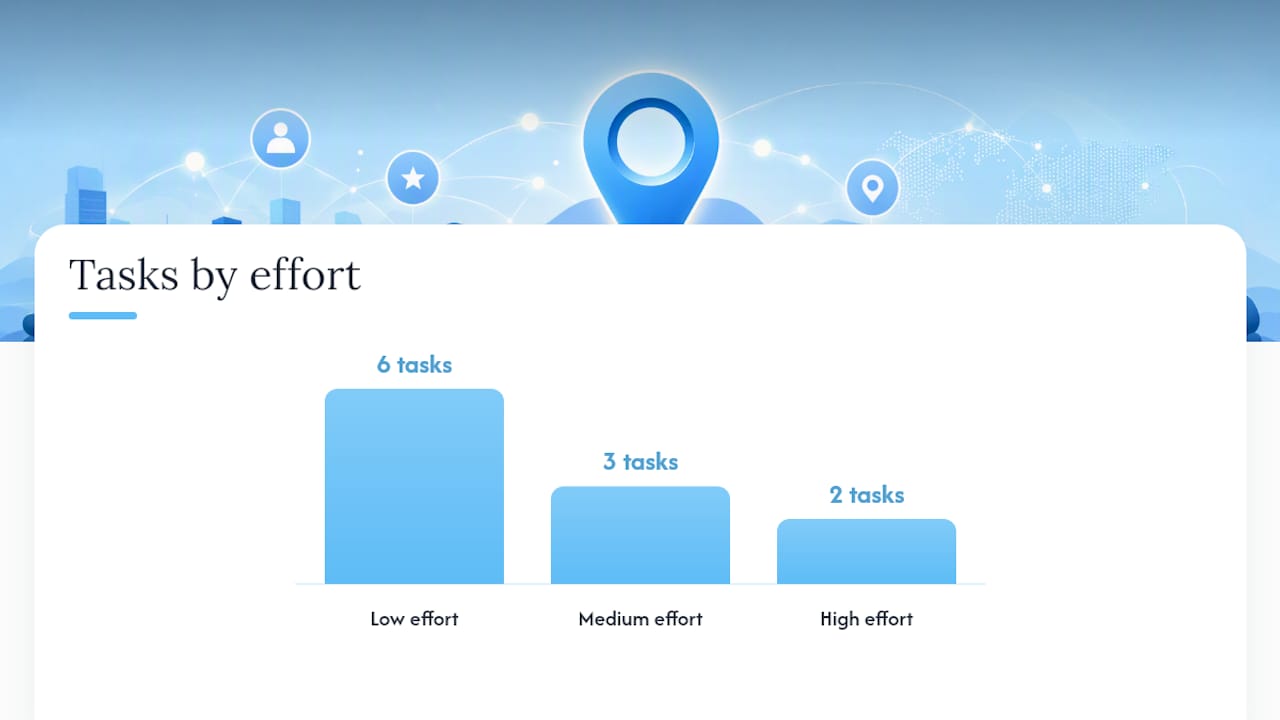
Most of the first-month tasks are genuinely DIY-able with no budget beyond your time. The medium-effort tasks in weeks three and four, location pages and directory submissions, take two to four hours each. Link building and content creation in months two and three are where many small business owners find it worth bringing in help.
Free checklist and interactive templates
The checklist above is designed to be copied into a spreadsheet and used as a living document. Here is what a working template looks like in practice:
Sample checklist rows:
- Task: Claim and verify GBP | Status: Done / In progress / Not started | Notes: Verified by postcard 12 March 2026
- Task: Canonical NAP recorded | Status: Done | Notes: “TTOY Digital, 12 High Street, Chesterfield, S40 1AA. 01246 000000”
The most important column is “Canonical NAP”, record it once at the top of your spreadsheet and copy it into every row that involves a directory or citation. That single habit prevents the inconsistencies that quietly suppress rankings for months.
For a free interactive version, localseochecklist.org offers a printable and fillable checklist you can work through task by task. Save a copy, share it with anyone helping you, and revisit it every six months.
How to run a quick 11-point local SEO audit
A complete local SEO audit covers 11 areas: keyword and AI-prompt audit, website technical health, GBP completeness, reviews, citations, backlinks, local content, schema, Google Search Console, analytics, and competitor analysis. Here is how to score each one quickly:
| Audit area | Green (no action) | Amber (fix soon) | Red (fix now) |
|---|---|---|---|
| GBP completeness | All fields complete, verified | Missing photos or services | Unverified or suspended |
| NAP consistency | Identical across all sources | Minor variations | Major conflicts or duplicates |
| Reviews | several reviews, responding to all | Under 10 reviews | No reviews or unresponded negatives |
| Schema | LocalBusiness block validated | Schema present but errors | No schema |
| Technical health | Mobile score 70+, no crawl errors | Speed issues, minor errors | Pages not indexed or blocked |
| Local content | Two+ location pages, unique content | One thin page | No location pages |
| Citations | Listed in top 10 UK directories | Partial listings | Not listed or major errors |
| Backlinks | Five+ local links | One or two links | No local links |
| GSC/GA4 | Set up, location pages tracked | Set up but not segmented | Not set up |
| Competitor analysis | Reviewed quarterly | Reviewed annually | Never reviewed |
| AI/voice readiness | FAQ schema, structured answers | Some FAQ content | No structured content |
Score each area, count your reds, and fix those first. The Search Engine Journal 11-point audit framework recommends revisiting the full audit every six to twelve months.
How does local social media help your local SEO?
Social media does not directly influence Google rankings, but it supports local SEO in two practical ways. First, consistent posting with location tags and local hashtags increases the chance that your business appears in social search results, which is increasingly where younger customers look first. Second, social content that gets shared locally can earn mentions and links from local websites, which do influence rankings.
The most effective approach for a small business is to post regularly on the platforms your customers actually use (Facebook and Instagram for most trades and retail, LinkedIn for B2B services), tag your location in every post, and occasionally share content that references local events, landmarks, or community news. That local specificity is what makes a post shareable within your area rather than just scrolled past.
How do you get into the Google Maps local pack?
The local pack, the three businesses that appear in a map box at the top of local search results, is driven by three factors: relevance (does your GBP match the query?), distance (how close is your business to the searcher?), and prominence (how well-known and trusted is your business online?).
You cannot control distance, but you can control relevance and prominence. Relevance comes from a complete, accurately categorised GBP with services that match what people search for. Prominence comes from reviews, citations, backlinks, and a website that Google trusts. The practical implication: a business with 60 reviews, consistent NAP, and a complete GBP will appear in the local pack for more queries than a business with a better website but a neglected profile.
Google Posts are an underused tool here. Publishing a short post to your GBP weekly, a promotion, a completed job, a local event, signals to Google that the profile is active and managed. Active profiles tend to rank higher than dormant ones with identical underlying data.
How do you handle negative reviews without making things worse?
The instinct when a bad review lands is to either ignore it or fire back. Both responses make things worse. Ignoring a negative review signals to prospective customers that you do not care; arguing publicly signals that you are difficult to work with.
The approach that works is to respond within 24 hours, keep the response under 60 words, and move the conversation offline. Acknowledge the experience, apologise for the frustration (not necessarily for wrongdoing), and give a direct contact, email or phone, where you can resolve it. That response is not really for the reviewer; it is for the next ten people who read it.
For reviews that violate Google’s policies, spam, fake reviews from competitors, or content that includes personal information, you can flag them for removal. The process is not instant and success is not guaranteed, but it is worth attempting. The TTOY Digital guide on removing a Google review covers the UK flagging process step by step.
One compliance note: in the UK, the Consumer Protection from Unfair Trading Regulations 2008 prohibits businesses from publishing fake positive reviews or suppressing genuine negative ones. Stick to ethical review generation only.
How do you measure local SEO ROI and which KPIs matter most?
The KPIs that translate most directly to revenue for a local business are: phone calls from GBP, direction requests, organic visits to location pages, and contact form completions. These are behavioural signals, they tell you whether people are actually taking action, not just finding you.
Set up a simple monthly report covering:
- GBP calls and direction requests (from GBP Insights)
- Organic sessions to location pages (GA4, filtered by organic source)
- Keyword rankings for your top five service-plus-location queries (BrightLocal or SEMrush)
- Review count and average rating (tracked manually or via BrightLocal)
- Citation consistency score (BrightLocal or localseochecklist.org)
To calculate ROI, estimate the average value of a new customer and multiply by the number of new customers attributable to local search. That figure makes the case for continued investment far more clearly than any ranking report.
The honest truth about local SEO for small businesses
Local SEO is not complicated, but it is relentless. The businesses that rank consistently are not the ones who did a big push two years ago, they are the ones who claimed their GBP, kept their details accurate, asked for reviews every week, and published something local every month. That is not a technical challenge. It is a habit challenge.
The bottleneck for most small business owners is not knowledge. It is time. You know you should respond to that review, update your GBP hours for the bank holiday, and publish that case study about the job in Ripley. But the phone is ringing and there are invoices to send. The work that drives local rankings keeps slipping to the bottom of the list.
Starting small genuinely works. Spend 90 minutes this week on GBP. Next week, fix your NAP on Yell and Bing Places. The week after, ask three recent customers for a review. That rhythm, sustained over three months, produces more visible results than a one-off sprint. And if you reach a point where delegating makes more sense than doing it yourself, that is a perfectly rational decision, not a failure.
TTOY Digital handles the checklist so you can run your business
Running through this checklist yourself is absolutely possible. But if you would rather hand it to someone who does this every week for small businesses across Derbyshire, South Yorkshire, and Nottinghamshire, that is exactly what TTOY Digital offers.
We typically start with a full 11-point audit, fix GBP and citations in the first two weeks, then move into location pages, review flow setup via SmartFlowCRM, and monthly reporting. No jargon, no long-term lock-in on the initial audit, and you always know what we are doing and why.
If you are based in Derbyshire or the surrounding area and want a straight conversation about where your local visibility stands right now, get in touch with the team at TTOY Digital. We will tell you honestly what needs fixing and what can wait.
Sources
FAQ
What is included in local SEO?
Local SEO covers optimising your Google Business Profile, making your NAP consistent across directories, collecting and responding to reviews, adding LocalBusiness schema, publishing location-specific pages, and building local backlinks. The five highest-impact elements are GBP, reviews, NAP consistency, on-page signals, and local content.
What is an SEO checklist?
An SEO checklist is a structured list of tasks that covers the main ranking factors for a given type of search visibility. A local SEO checklist focuses specifically on the signals that influence where a business appears in local and map-based search results.
Is SEO dead or evolving in 2026?
SEO is evolving, not dying. Generative AI tools like ChatGPT and Perplexity now surface local business recommendations, which means structured content, active GBP profiles, and consistent NAP matter more than ever, not less. Businesses that ignore local SEO in 2026 are invisible to both traditional and AI-powered search.
Can I do local SEO myself?
Yes. The first-month tasks, claiming GBP, fixing NAP, adding schema, and setting up GSC and GA4, are all achievable without technical expertise. Content creation and link building take more time, and many small business owners find it practical to handle the basics themselves and delegate the ongoing work to an agency.