
Review gating means screening customers by how happy they are before deciding who gets asked to leave a public review. The short verdict: it’s not permitted. Google Business Profile explicitly bans it, and under the UK’s Digital Markets, Competition and Consumers Act 2024, the Competition and Markets Authority treats selectively soliciting only satisfied customers as a misleading practice. If you’re running this now, stop.
The fix isn’t complicated:
- Invite every customer to leave a public review, regardless of how the interaction went
- Offer a separate, optional private feedback channel for anyone who wants to vent first
- Never let sentiment decide who sees the public review link
Key Takeaways
Review gating is banned under Google’s policies and breaches UK consumer protection law by selectively soliciting only positive reviews.
| Point | Details |
|---|---|
| Definition | Review gating means using customer sentiment to decide who gets invited to leave a public review. |
| Legal exposure | The CMA and DMCC Act 2024 treat selective review solicitation as a misleading commercial practice. |
| Platform enforcement | Google names review gating as a specific policy violation and can suppress or remove affected profiles. |
| Compliant alternative | Invite every customer equally and offer a separate private feedback channel alongside it, not instead of it. |
| Getting help | TTOY Digital’s reputation management and SmartFlowCRM services help audit and replace gating automations with compliant workflows. |
Table of Contents
- What does review gating actually look like?
- Why review gating carries real legal and platform risk
- How Google and review platforms treat gating
- What compliant review collection looks like
- Spotting gating hiding in your own systems
- Fixing past gating: a short remediation plan
- Sources
- FAQ
What does review gating actually look like?
Most gating happens through a simple automated flow: a customer answers a quick satisfaction question, and the system routes them accordingly. Say “great” and you get a link to Google or Trustpilot. Say “not great” and you’re quietly diverted to a private contact form that never sees daylight.
We’ve seen this dressed up in three common ways, a pattern echoed by many local businesses in Southern California. A post-purchase email asks “How did we do?” with a 1 to 5 star selector, and only 4s and 5s trigger the public review request. A member of staff is told, informally, to “ask the happy ones” for a Google review at checkout. Or a reputation management tool ships with a “smart routing” toggle that does the sentiment split automatically, often switched on by default.
The test is straightforward: does a customer’s satisfaction level ever determine whether they’re shown the public review invitation? If yes, that’s review gating, whatever the vendor calls it.
Why review gating carries real legal and platform risk
Under CMA guidance, traders must publish reviews without misleading consumers and take “reasonable and proportionate steps” to prevent, detect and remove fake or unfair reviews. Selectively harvesting only positive feedback and hiding negative experiences from public view sits squarely inside what the Gov warns against.
Traders must not publish reviews in a misleading way and must take reasonable and proportionate steps to prevent, detect and remove fake or misleading reviews.
Enforcement attention on manufactured review profiles has been building for a while. Reuters reported on Google’s own legal action against fake review operations, a sign that platforms and regulators are both taking litigation routes seriously rather than treating this as a policy footnote.
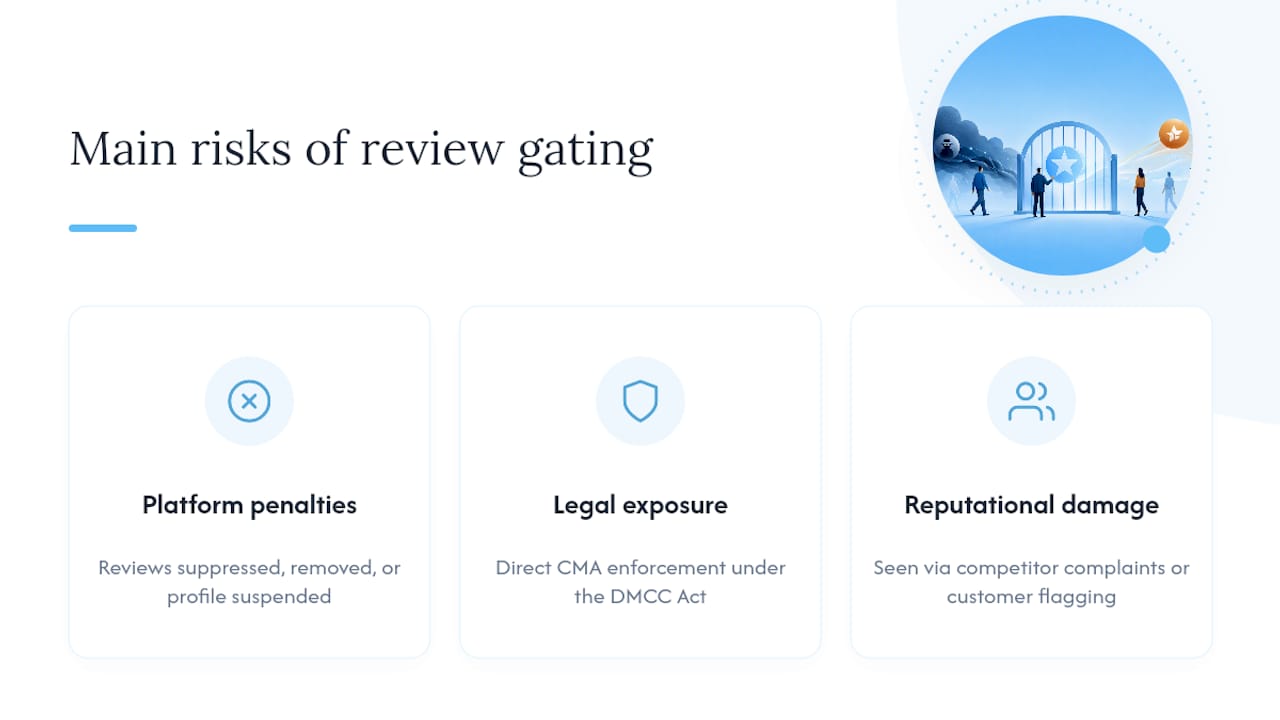
For a small business, the practical fallout tends to land in three places. First, platform penalties: Google can suppress or remove reviews, and in worse cases, suspend the whole profile. Second, legal exposure under the DMCC Act, which gives the CMA direct enforcement powers rather than relying solely on court action. Third, reputational damage once a gating pattern becomes visible, either through a competitor complaint or a customer noticing they were never asked.
How Google and review platforms treat gating
Google’s own support threads name review gating directly as a policy violation, describing exactly the pattern above: filtering customers before extending a review invitation. Business Profile guidelines require that every customer gets the same opportunity to leave feedback, good or bad.
Third-party platforms follow a similar line. GOV.UK’s reviews guidance for online review sites expects publishers to carry all genuine, lawful, relevant reviews and to be transparent about how those reviews were collected, with moderation that doesn’t quietly filter out the negative ones. Trustpilot and similar hosted review widgets operate on the same principle: selective solicitation undermines the credibility of the whole platform, which is why detection triggers usually mean removal of the affected reviews or a formal note on your profile rather than a quiet warning.
What compliant review collection looks like
The alternative to gating isn’t complicated, and it doesn’t cost you conversion the way you might assume. It’s simply asking everyone.
- Send the same review invitation to every customer who completes a purchase or booking, with no satisfaction filter in front of it.
- Verify the interaction happened (order number, appointment date) rather than verifying how the customer felt about it.
- Offer a private feedback option alongside the public one, not instead of it, so unhappy customers still have somewhere to go.
- Time the request sensibly, shortly after delivery or service completion, when the experience is fresh.
A publishable review policy should cover:
- How and when review invitations go out
- Whether any incentive is offered, and to whom
- What moderation rules apply (and confirmation that genuine negative reviews aren’t blocked)
- How long you retain records of who was invited and when
Pro Tip: Wording that boosts response rates without touching sentiment usually works better than gating anyway. “We’d love your honest feedback, good or bad” tends to outperform generic asks, because it signals you’re not fishing for five stars. Before rolling out any vendor’s review tool, check the settings for a “feedback routing” or “smart filter” toggle. Some are gating in disguise.
Spotting gating hiding in your own systems
Gating rarely announces itself. It usually lives quietly inside an automation nobody’s audited in a year. Look for:
- Conditional review links that only fire above a certain star rating or NPS score
- CRM workflows with an “if satisfied, then invite” branch
- Third-party reputation tools with routing or filtering switched on by default
- Staff informally told to “ask the happy ones” at the till or on the phone
To audit properly, pull the actual automation rules from your CRM or email platform, not just the customer-facing templates, and check your Google reviews against what your invitation logs suggest you sent out. If the two don’t match up, that gap is worth investigating.
Fixing past gating: a short remediation plan
If you find gating in your process, the sequence is straightforward.
- Switch off any conditional logic immediately and pause the affected campaign.
- Re-run a universal invitation to the customers who were previously filtered out, so the public record reflects everyone, not just the satisfied ones.
- Document what changed, when, and why, and update your published review policy to match.
- Brief staff on the new process and keep a note of any vendor conversations about disabling routing features.
Pro Tip: Keep your remediation documentation even after you’ve fixed the process. If a platform or regulator ever asks questions, being able to show the date you disabled gating and re-ran invitations does a lot of the work for you. If a review needs correcting rather than removing, our guide on removing a Google review walks through the legitimate routes.
Why authentic, mixed feedback earns more trust
A profile with nothing but five-star reviews tends to look manufactured, and customers are increasingly good at spotting that. A mix of positive and honest constructive feedback generally reads as more credible, which is often reflected in stronger conversion than a suspiciously perfect score. From what we’ve seen in reputation management work, honest reviews also tend to carry more long-tail search value, since customers write in the natural language other searchers actually use. Compliance and commercial sense point the same direction here.

How TTOY Digital helps you move off gating for good
If your review process needs untangling, that’s exactly the kind of manual bottleneck TTOY Digital was built to fix. Our reputation management service audits your existing review flows, spots any gating hiding inside vendor settings or CRM rules, and replaces it with a universal, compliant invitation process. Where the gating lived inside a clunky automation, SmartFlowCRM pulls WhatsApp, email and review requests into one system, so every customer gets the same fair ask without you having to babysit the workflow. If you’re not sure whether your current setup counts as gating, get in touch and we’ll run through it with you, no obligation, just a straight answer.
Sources
This article is general information, not a substitute for advice from a qualified lawyer. Consult a qualified legal professional about your own circumstances before acting on anything here.
FAQ
What does review gating mean?
Review gating means screening customers by satisfaction before deciding who gets invited to post a public review, typically routing happy customers to Google or Trustpilot and unhappy ones to a private form.
What is review gating on Google reviews?
On Google Business Profile, gating means only asking satisfied customers for a public review while diverting dissatisfied ones elsewhere. Google names this as a policy violation and can act against profiles that do it.
What is a review gate?
A review gate is the mechanism, often a satisfaction question or star selector, that filters customers before they reach the public review link. If sentiment decides who sees that link, it’s a gate.
What are 5 star reviews examples?
A genuine five-star review typically names a specific service detail (a job done on time, a helpful staff member) rather than reading like generic praise. Businesses should never engineer their review profile to show only these by filtering out lower scores; a mix of ratings collected through a universal invitation process, as TTOY Digital sets up for clients, tends to read as more trustworthy overall.