
You cannot delete a Google review yourself. Only Google can remove one, and only when it violates its content policies. The single best thing you can do right now is take a screenshot of the review and its URL before anything else disappears.
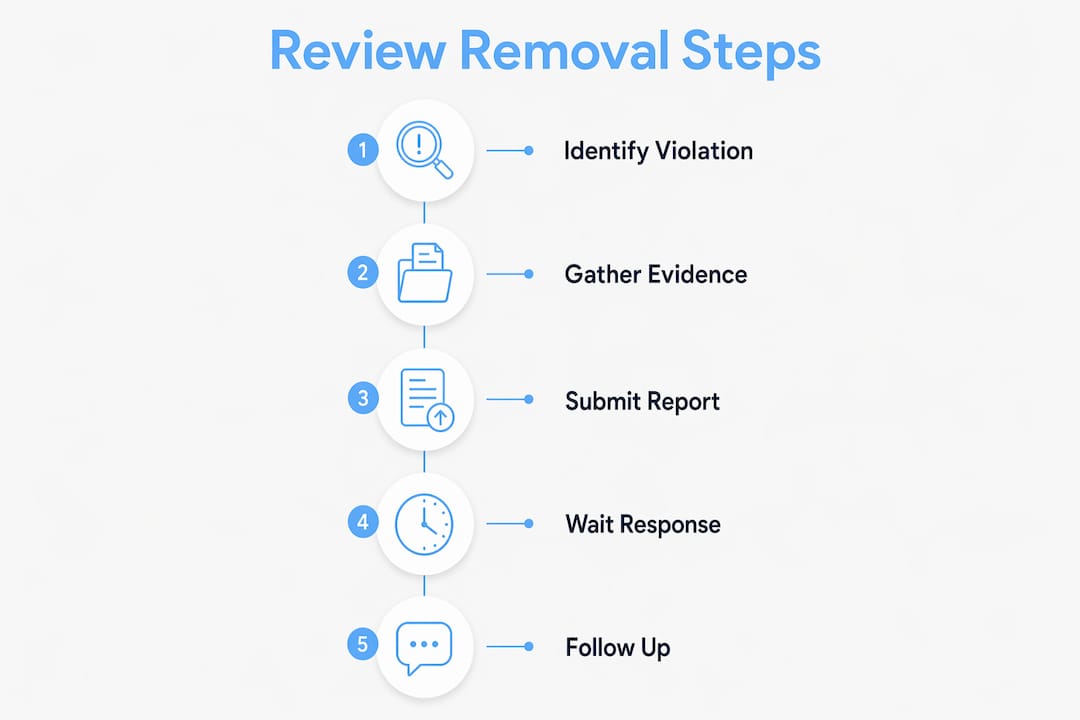
Google’s policy enforcement is not about fairness. An authentic one-star review from a genuinely unhappy customer will stay up, full stop. What Google does act on is clear policy breaches: spam, fake accounts, harassment, conflict of interest, and off-topic content. Many clear violations are removed quickly; more complex cases go to a human reviewer and may require several weeks.
Your first-hour checklist:
- Screenshot the review (full screen, including the reviewer’s name and star rating)
- Copy and save the review URL from your browser address bar
- Note the date and time the review appeared
- Check your transaction records for any customer match
- Log into Google Business Profile and flag the review immediately
- Save your flag confirmation email
Pro Tip: Submit your report once and wait. Duplicate submissions are flagged by Google’s automated systems and can push your case to the back of the queue.
Table of Contents
- What should you do in the next 24–72 hours?
- How does Google decide whether to remove a review?
- How do you build and submit a removal request?
- What if the review is authentic but damaging?
- What legal routes are available to UK businesses?
- When does hiring a reputation-management agency make sense?
- Key takeaways
- Why specialists often save you more than they cost
- TTOY Digital’s reputation management service
- Useful sources
- FAQ
What should you do in the next 24–72 hours?
Speed matters here, because reviewer profiles and messages can disappear.
- Capture ephemeral evidence first. Screenshot the reviewer’s full profile page, including their review history and account age. If they’ve sent you threatening messages via WhatsApp or email, screenshot those too and back them up to Google Drive or OneDrive immediately.
- Export your transaction records. Pull any booking confirmations, invoices, or CRM records for the period the reviewer claims to have visited. A clear transaction mismatch is one of the strongest signals you can give Google.
- Note any staff involved. Write down who served the customer (or who didn’t, if the reviewer was never actually a customer), with dates and times.
- Post a public reply. Keep it brief and professional. Something like: “We’ve searched our records and can’t find a transaction matching this review. Please contact us directly at [email] so we can look into this.” Do not accuse the reviewer of lying, even if you’re certain they are.
- Gather communication logs. If the reviewer contacted you before posting, save those messages. A pattern of demands followed by a negative review is strong evidence of extortion.
Evidence that moves a case from automated to human review:
- Timestamped screenshots of the review and reviewer profile
- Transaction records showing no matching customer
- CRM or booking-system exports covering the relevant dates
- Screenshots of any threatening or extortionate messages
- Evidence of a pattern (multiple reviews from linked accounts)
Pro Tip: If threatening messages arrived via WhatsApp, use your phone’s screen-record function rather than just a screenshot. A short video showing the conversation thread, with timestamps visible, is harder to dispute.
How does Google decide whether to remove a review?
Google enforces its content policies, not subjective fairness. A review that is harsh, unfair, or simply wrong about the facts will stay up unless it crosses a specific policy line.
The categories Google acts on:
- Spam and fake content: accounts with no review history, duplicate text across multiple businesses, or reviews posted in bulk
- Fake and misleading content: reviews from people who never transacted with the business, or fabricated experiences
- Conflict of interest: reviews from competitors, employees, or associates
- Harassment and hate speech: personal attacks, threats, or discriminatory language
- Personal information: reviews containing someone’s private data
- Off-topic content: reviews about a different location, a political grievance, or an unrelated experience
The distinction that trips most owners up is this: a real customer who had a genuinely bad experience and wrote a scathing review is not violating policy. Google will not remove it because you disagree with it. Choosing the right reporting category also matters. Industry guidance consistently shows that “Fake and misleading content” outperforms the generic “Spam” category when the review comes from a single hostile account with no transaction history.
A word of caution: Do not post fake positive reviews to dilute a bad one, and do not ask friends or family to flag the review en masse. Both tactics violate Google’s policies and can result in your Business Profile being penalised or suspended. One well-documented report beats ten poorly evidenced ones every time.
How do you build and submit a removal request?
There are four routes, and the right one depends on the nature of the review.
Step-by-step via Google Business Profile (the standard route):
- Go to business.google.com and sign in
- Click “Reviews” in the left-hand menu
- Find the review, click the three-dot menu beside it, and select “Report review”
- Choose the most specific policy category that fits
- Add a concise explanation citing the exact policy and your evidence
- Submit and save the confirmation email
You can also flag a review directly from Google Maps or Search by clicking the three-dot menu next to the review. If neither route produces a result within around two weeks, escalate via Google Business Profile Support (support.google.com/business) and reference your original confirmation number.
For extortion cases, Google introduced a dedicated Merchant Extortion form recently, routed directly to the Trust & Safety team. Clear extortion cases can sometimes be resolved rapidly through this channel.
Expected processing windows:
| Stage | Typical timeframe |
|---|---|
| Automated scan (clear violations) | typically within a few days |
| Human policy review | approximately one to two weeks |
| Appeal after initial “no violation” | may take several weeks |
| Legal removal request | Several weeks to months |
An initial “no policy violation” response is not the end of the road. Most initial reports are processed automatically without a human ever seeing your evidence. A well-crafted appeal, with specific policy citations and documented proof, is where human reviewers actually weigh your case.
What if the review is authentic but damaging?
If the review is genuine, Google will not remove it. That does not mean you’re helpless.
A calm, factual public reply does two things: it shows prospective customers that you take feedback seriously, and it often defuses the situation. Keep your reply under 100 words, acknowledge the concern without admitting fault where none exists, and invite the customer to contact you offline. Google’s own guidance recommends professional replies and review-generation strategies when policy removal is not an option.
Do’s and don’ts:
- Do respond within 48 hours, professionally and without emotion
- Do invite the reviewer to resolve the issue privately
- Do ask satisfied customers to leave honest reviews (verbally, via email, or with a QR code at your till)
- Don’t offer discounts or gifts in exchange for reviews, that breaches Google’s policy
- Don’t threaten legal action in a public reply
- Don’t ask customers to remove or change their reviews in exchange for a refund
Generating a steady flow of genuine reviews from happy customers is the most durable mitigation strategy. One three-star review among many four and five-star reviews carries far less weight than the same review sitting alone on a thin profile.
Pro Tip: Your local SEO profile is stronger when reviews arrive consistently over time, not in sudden bursts. A natural review cadence also signals authenticity to Google’s algorithms.
What legal routes are available to UK businesses?
Legal action is slower and more expensive than most owners expect. It is not a fast path to removal.
When to consult a UK solicitor:
- The review contains a false statement of fact that has caused you quantifiable financial loss (potential defamation claim)
- The reviewer is impersonating a customer or another business
- You are receiving threats or extortionate demands linked to the review
- An anonymous poster has published private information about you or your staff
A solicitor’s letter to Google or to the reviewer can sometimes prompt voluntary removal. For anonymous posters, a Norwich Pharmacal Order can compel Google to disclose the reviewer’s identity, though this is a High Court process and not inexpensive. Cost bands vary widely: a solicitor’s letter typically runs into hundreds of pounds; a full defamation claim can reach tens of thousands.
Important: Defamation law in England and Wales requires you to show that a statement is false, that it was published to a third party, and that it caused or is likely to cause serious harm to your reputation. A harsh opinion, even an unfair one, is not defamation. Always take qualified legal advice before pursuing this route.
Legal routes do not guarantee removal from Google. Even a successful court order requires a separate submission to Google’s legal team, and processing takes additional time.
When does hiring a reputation-management agency make sense?
If you’ve spent more than a week on this and the review is still up, or if the situation involves multiple fake reviews, extortion, or legal complexity, a specialist agency is worth considering.
What a reputable agency can do:
- Collect and organise evidence to a standard that satisfies human reviewers
- Draft and submit appeals with precise policy citations
- Escalate via the Merchant Extortion channel and Business Profile Support
- Run ethical review-generation campaigns to rebuild your rating
- Liaise with solicitors when legal escalation is warranted
- Monitor your profile for new attacks
Questions to ask before you hire:
- What is your track record with cases similar to mine?
- Do you use only Google-compliant methods?
- How do you handle evidence, and who has access to it?
- What does your service-level agreement say about escalation timelines?
- Do you guarantee removal? (The honest answer is always no.)
No agency can guarantee that Google will remove a specific review. Anyone who promises otherwise is not being straight with you. What a good agency can promise is a thorough, well-documented process that gives your case the best possible chance.
Pro Tip: Ask any agency for an anonymised example of a case they’ve handled. A credible agency will be able to describe the process and outcome in general terms, even if they cannot share client details.
Key takeaways
Removing a damaging Google review requires evidence, the right reporting channel, and realistic expectations about what Google will and will not act on.
| Point | Details |
|---|---|
| Google enforces policy, not fairness | Only reviews breaching content policies are removed; authentic negative reviews stay up. |
| Evidence is everything | Screenshots, transaction records, and communication logs are what move a case to human review. |
| One submission, then appeal | Duplicate reports are deprioritised; submit once, wait, then appeal with stronger evidence. |
| Legal routes are slow | UK defamation claims and Norwich Pharmacal Orders take months and carry no removal guarantee. |
| TTOY Digital can help | TTOY Digital handles evidence collection, appeal drafting, escalation, and reputation repair for UK small businesses. |
Why specialists often save you more than they cost
There’s a pattern we see regularly. A business owner spots a damaging review, reports it once, gets the automated “no violation” response, and then either gives up or starts resubmitting the same report in frustration. Both responses make the situation worse.
The owners who get the best outcomes are the ones who treat this like a documented case rather than an emotional complaint. That means precise policy citations, not “this is unfair.” It means transaction records, not just a denial. And it means knowing when to escalate to a human reviewer versus when to shift strategy toward reputation repair.
DIY removal is absolutely possible when the violation is clear and the evidence is strong. But when the situation involves multiple fake reviews, a hostile campaign, or any legal dimension, the time you spend learning the process is time your rating is sitting damaged in front of every prospective customer who searches for you. A specialist who has navigated these channels before will move faster, make fewer costly mistakes, and keep communications measured when emotions are running high.
TTOY Digital’s reputation management service
Dealing with a damaging review while running a business is genuinely difficult. TTOY Digital works with small businesses across England to handle the evidence-gathering, appeal drafting, and escalation process so you don’t have to learn it under pressure.
The service covers evidence collection and organisation, appeal submissions with specific policy citations, Merchant Extortion escalation where relevant, ethical review-generation campaigns to rebuild your profile, and ongoing monitoring to catch new issues early. No removal is ever guaranteed, and we’ll always tell you that plainly. What we do guarantee is a thorough, compliant process that gives your case the strongest possible foundation.
If you’d like to talk through your situation, get in touch with TTOY Digital for an initial consultation. We’ll tell you honestly what’s achievable and what the realistic timeline looks like.
Useful sources
- Google Business Profile Help: Report inappropriate reviews, the official policy reference for what Google removes and the flagging process from your dashboard.
- Google Maps Help: Add, edit, or delete reviews, explains how reviewers can edit or delete their own reviews, and how any user can flag a review from Maps or Search.
- Praising.ai: How to report fake reviews on Google Business Profile, a practical step-by-step guide covering all four reporting methods and what to expect after submission.
- TrueReview: How to remove fake Google reviews (2026 guide), covers the Merchant Extortion escalation channel, appeal strategy, and category selection guidance.
- Saphek: Can you delete a Google review?, clear explanation of the policy enforcement vs. fairness distinction, with guidance on public replies and review generation.
FAQ
Can you delete a Google review yourself?
No. Only the reviewer or Google can remove a review. As a business owner, you can flag it for policy violation and submit an appeal, but you cannot delete it directly.
How long does it take Google to remove a review?
Clear policy violations are often removed within 24–72 hours by automated systems. Cases requiring human review typically take 5–10 business days; appeals can take 2–4 weeks.
What counts as a fake Google review under Google’s policy?
A fake review is one posted by someone who never transacted with the business, or one that is part of a coordinated spam or competitor-sabotage campaign. Harsh but genuine customer feedback does not qualify.
Should you report a fake Google review more than once?
No. Submitting the same report multiple times causes automated systems to deprioritise your case. Submit once, wait for the outcome, then file a single well-evidenced appeal if needed.
When should a UK business consider legal action over a review?
Consult a UK solicitor when a review contains a provably false statement of fact causing financial harm, involves impersonation, or is linked to threats or extortion. Legal routes are slow and carry no guarantee of Google removal.
Related reading: Online reputation management for SMEs · Schema for local business: your practical UK guide