
Start here: claim your Google Business Profile first, then Bing Places for Business, Apple Business Connect, Yell.com, and Foursquare, in that order. Once those five are live, run a quick NAP audit (Name, Address, Phone) to check they all say exactly the same thing.
That’s the whole game in one sentence. Everything else is detail.
Do this first (under 30 minutes):
- Claim or verify your Google Business Profile: takes about 5 minutes to set up, though Google’s postcard or phone verification can add a few days.
- Set up Bing Places for Business: often auto-imports your Google listing, so this can take under 10 minutes.
- Add or claim your listing on Foursquare: this one matters more than most business owners realise, because its data feeds into a surprising number of apps and AI pipelines downstream.
- Create or claim your profile on CitedX, a free UK directory built with schema markup specifically so AI engines can read and cite your listing.
Do those four, and you’ve covered the sites that carry the most weight for both traditional local search and the newer wave of AI-powered search tools.
Key Takeaways
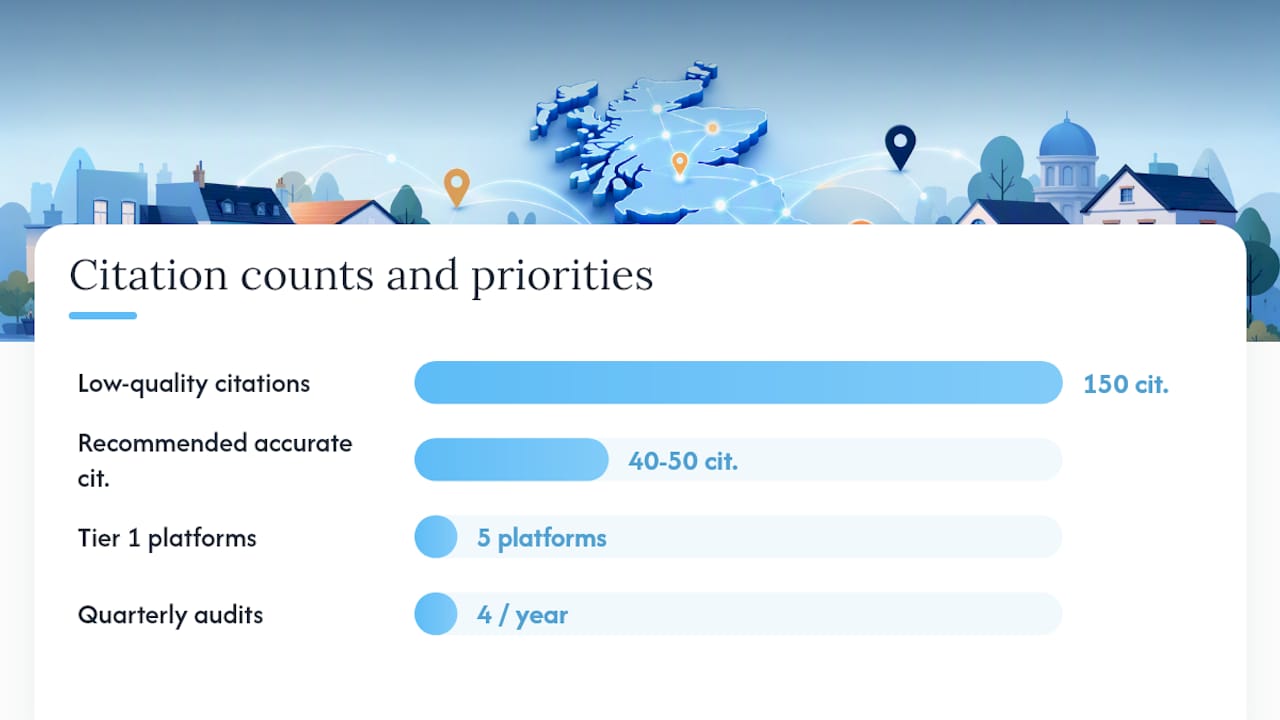
Consistent NAP across Tier 1 platforms, built in priority order and audited quarterly, is the single most reliable lever for improving UK local search and AI citation visibility.
| Point | Details |
|---|---|
| Claim Tier 1 first | Google Business Profile, Bing Places, Apple Business Connect, Yell and Foursquare carry the most ranking weight. |
| Match NAP exactly | Copy your name, address and phone from Google Business Profile character for character onto every other listing. |
| Add schema to your site | LocalBusiness schema on your own website reinforces every citation pointing back at it. |
| Quality beats quantity | Around 40 to 50 accurate citations typically outperform 150 low-quality, unchecked ones. |
| Get professional support if needed | TTOY Digital runs citation audits and tiered builds as part of its local SEO retainers for UK small businesses. |
Table of Contents
- What are the essential local citations UK businesses need?
- How do you claim or create a UK business citation?
- How do you audit and fix inconsistent citations?
- What common citation mistakes hurt local SEO?
- How does a local SEO agency manage citations for UK SMEs?
- A practitioner’s view on quality over quantity
- Get your citations sorted without doing it all yourself
- Sources
- FAQ
What are the essential local citations UK businesses need?
Not every directory deserves your time. Some carry real ranking weight; others are digital wallpaper. Here’s how we’d sort them if you handed us your business today.
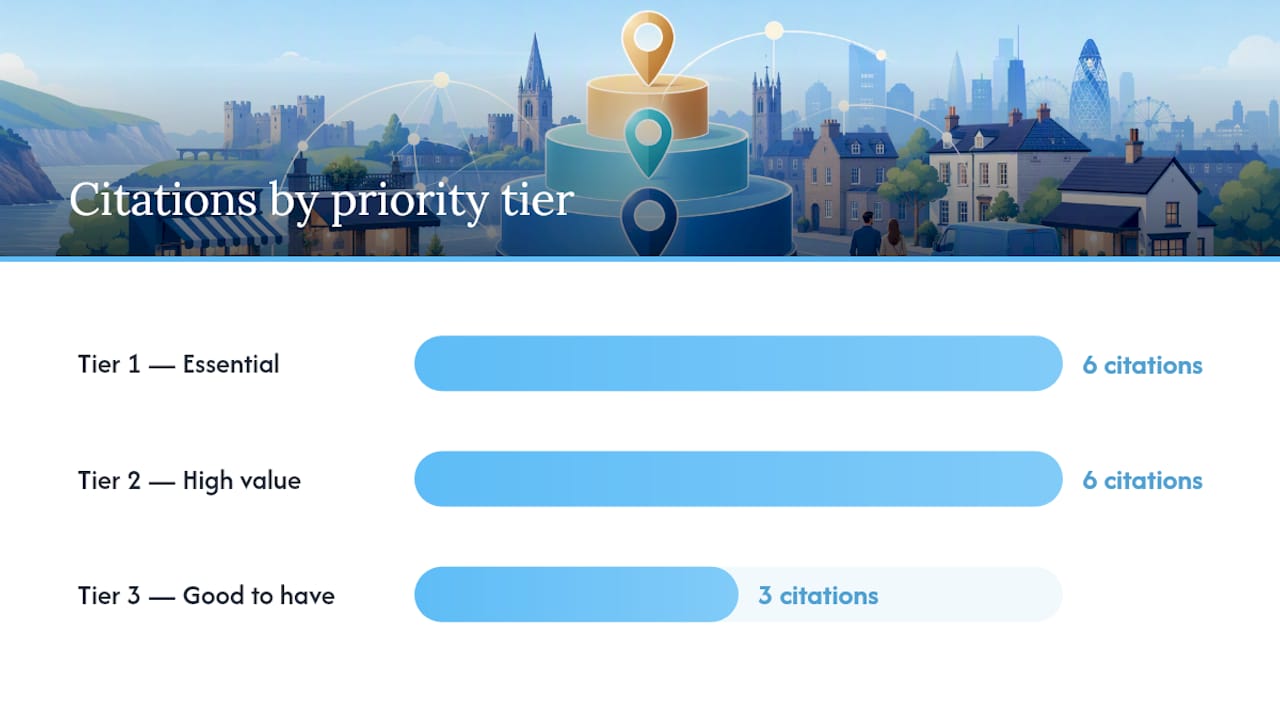
Tier 1: Essential (do these this week)
- Google Business Profile: the single biggest local ranking signal there is, and the one place customers actually look before they call you. Free. Claim manually, verify by phone or postcard.
- Bing Places for Business: smaller search share than Google, but Microsoft Copilot and Windows search both pull from it. Free, 10 minutes.
- Apple Business Connect: controls how you appear in Apple Maps and Siri results, which matters enormously if your customers are on iPhones (most of the UK is). Free, manual claim.
- Yell.com: still one of the highest domain-authority UK directories, according to BrightLocal’s citation research. Free basic listing, paid upgrades available.
- Foursquare: low profile with consumers, high value as a data aggregator that feeds other apps and AI tools. Free, 10 to 15 minutes.
- OpenStreetMap: powers a surprising number of navigation apps behind the scenes. Free, slightly more technical to edit.
Tier 2: High value (do these within a month)
- Thomson Local: a legacy UK directory that still carries decent authority. Free basic tier.
- FreeIndex: genuinely free, structured citation with good local relevance.
- Trustpilot: not a traditional citation, but review signals increasingly blend into local ranking and AI trust scoring.
- TripAdvisor: essential if you’re hospitality, tourism or food and drink; skip it if you’re a plumber.
- Facebook Business Page: most customers check this before your website, particularly for opening hours.
- LinkedIn Company Page: less about local ranking, more about B2B credibility and staff attribution.
Tier 3: Good to have
Industry directories (trade bodies, professional registers), local press directories, and your regional Chamber of Commerce. These are unstructured citations, meaning they mention your business rather than hosting a formal profile, but Google still reads them as trust signals.
Pro Tip: Foursquare feels like the odd one out on this list because almost nobody searches it directly. Claim it anyway. Its data pipeline reaches chatbots, mapping apps and AI assistants that most business owners never think to check.
How do you claim or create a UK business citation?
The process is nearly identical everywhere, and most mistakes happen because someone rushes the details on listing number three when they were still being careful on listing number one.
- Search first. Type your business name and postcode into Google and each directory’s own search bar. Directories often auto-generate listings from data brokers, so a “duplicate” may already exist.
- Claim if it exists, create if it doesn’t. Claiming usually needs phone or email verification; creating fresh needs the same fields filled properly from the start.
- Enter your NAP exactly as it appears on Google Business Profile. If your GBP says “14 Market Street, Chesterfield, S40 1AB”, every other listing needs that exact format, not “14 Market St.” or “Chesterfield, Derbyshire”.
- Choose your primary category carefully, then add secondary categories only if they’re genuinely accurate. A “café” that lists itself under “restaurant” and “bar” too will confuse ranking algorithms rather than widen its net.
- Write a description that says what you actually do, using the words a customer would type into Google, not marketing language.
- Add photos, opening hours, website URL and services. Empty fields read as low-effort to both Google and the directory itself.
Behind the scenes, add LocalBusiness schema to your own website. This markup tells search engines and AI tools your name, address and phone number in a machine-readable format, which reinforces every citation pointing back at it.
Pro Tip: NAP consistency breaks on details nobody notices at a glance: “Street” versus “St”, “Ltd” appearing on one listing and missing on another, or your website listed as http:// on one directory and https://www. on the next. Pull up three of your listings side by side once a quarter and read the address fields character by character.
How do you audit and fix inconsistent citations?
Search “your business name” plus your postcode in quotation marks, then repeat with your phone number in quotation marks. Check the first three pages of results, Google Maps, and the major directories from Tier 1 and Tier 2 above.
Tools like BrightLocal and Whitespark scan dozens of directories in minutes and flag mismatches automatically, which beats manually checking each one. Manual checks still work fine for a single-location business with under 20 listings; the paid tools earn their fee once you’re managing multiple sites or franchise locations.
A single-location audit typically takes 45 minutes to an hour. Cleaning up 20 to 50 inconsistent listings across a business that’s moved premises or changed its phone number can take several hours spread across a week, since some platforms require email verification before they’ll accept an edit.
Where a listing was auto-generated incorrectly (a common issue tied to old Companies House filings or outdated Royal Mail address data), most directories have a “claim this listing” or “suggest an edit” flow. Use it rather than creating a second, competing profile.
Pro Tip: Fix your own website first. Directories and data aggregators periodically re-scrape business websites, so an outdated address on your site can quietly undo the audit work you just did across ten directories.
What common citation mistakes hurt local SEO?
- Inconsistent NAP: even small formatting differences confuse Google’s entity matching and dilute ranking confidence. Fix now.
- Duplicate listings: usually created when a directory auto-generates a profile before you claim the real one. Fix now; request a merge or removal.
- Wrong or overly broad categories: dilutes topical relevance for the searches that actually matter to you. Fix now.
- Empty or half-finished profiles: signal low effort and get outranked by competitors with complete listings. Schedule this week.
- Spammy, low-authority directories: add nothing and occasionally attract penalties if the site itself is flagged as low quality. Ignore or remove.
- Incorrect opening hours: a fast trust killer with customers, even though its direct SEO impact is smaller. Fix now.
- Mismatched website URLs (old domain, missing
https://, wrong subdomain), breaks the link between your citation and your actual site. Fix now.
How does a local SEO agency manage citations for UK SMEs?
A properly run citation programme isn’t a one-off task, it’s a workflow. Here’s roughly how it goes when handled professionally rather than left to chance:
- Discovery and NAP definition: agree the canonical version of your business name, address and phone number before touching a single directory.
- Tiered build: Tier 1 platforms first, then Tier 2, then sector-specific directories relevant to your trade.
- Aggregator submission: claiming feeds like Foursquare early, since correcting data at the aggregator level prevents it locking in wrong details across dozens of downstream sites.
- Audit and clean-up: finding and merging duplicates, correcting auto-generated errors.
- Ongoing monitoring: periodic rechecks, typically monthly or quarterly, since directories occasionally revert edits or re-scrape stale data.
You’ll usually need to provide login access or authorisation, and confirm the canonical NAP and category choices. In return you should get a CSV of every listing claimed, a NAP consistency score, and a written closing report.
A cleaned-up citation profile, with duplicates merged and NAP standardised across Tier 1 and Tier 2 sites, tends to show up in improved Google map pack visibility within a few weeks of the fix, once Google re-crawls the corrected data.
A practitioner’s view on quality over quantity
If you take one thing from this, take this: A moderate number of accurate citations will outperform a larger number of sloppy ones. We’d rather see a business nail its Tier 1 and Tier 2 listings than spend a weekend submitting to every free directory it can find. UK specifics matter more than people expect here. Companies House filings and Royal Mail’s address formatting quietly feed a lot of auto-generated listings, and regulated trades (solicitors, accountants, healthcare) need sector directories on top of the general ones. Our rule of thumb during an audit: if a citation doesn’t match your Google Business Profile character for character, it’s not finished yet, it’s a liability.
Get your citations sorted without doing it all yourself
There are DIY routes to citation building, and plenty of business owners do it themselves with a spreadsheet and a free Saturday afternoon. But if you’d rather your time went into running the business, TTOY Digital handles the whole thing: citation audits, Tier 1 to Tier 3 builds, LocalBusiness schema added to your website, and ongoing NAP monitoring so a directory glitch doesn’t quietly undo your ranking six months later. You give us access and your canonical business details; we give you a CSV of everything claimed and a written report showing what changed. If you want this folded into a broader push for Google visibility, our local SEO service in Chesterfield covers citation management as part of an ongoing retainer, with clear monthly reporting. Get in touch and we’ll tell you honestly whether your current listings need a full rebuild or just a tidy-up.
Sources
- Top UK citation sites | BrightLocal
- How to build a local citation strategy that boosts your map pack rankings | Dynamically
- Best UK Business Directories & Citation Sites | Whitehat
FAQ
What Are Local Citations in UK SEO?
A local citation is any online mention of your business name, address and phone number, whether it’s a full directory profile or a passing reference in an article. Consistency across them is what search engines use to confirm your business is real and accurately located.
Which UK Citation Sites Should I Claim First?
Start with Google Business Profile, Bing Places for Business, Apple Business Connect, Yell.com and Foursquare, since these carry the most weight for both traditional search rankings and AI-driven visibility.
How Long Does It Take to Build UK Citations?
Claiming the five Tier 1 listings usually takes under an hour combined. A full audit and clean-up across 20 to 50 existing listings tends to spread across several hours over a week or two, depending on verification delays.
Are Paid Citation Directories Worth It?
Rarely, at least at first. Most high-authority UK directories, including Yell and Thomson Local, offer free basic listings that carry real citation value; paid upgrades are worth considering only once your free Tier 1 and Tier 2 listings are complete and consistent.
Can TTOY Digital Manage My Citations for Me?
Yes. TTOY Digital audits existing listings, builds out Tier 1 through Tier 3 citations in priority order, and adds LocalBusiness schema to your website, all reported back with a clear CSV and written summary.