
Citation building is the process of creating and maintaining consistent online mentions of your business name, address, and phone number (NAP) across directories, apps, and social platforms. Before you read another word, open a new browser tab and search your exact business name alongside your phone number. What comes back tells you everything: duplicate listings, old addresses, wrong numbers, or a suspiciously thin presence. Note what you find. That is your starting point.
Key takeaways
Consistent, high-quality citations across 25–50 authoritative platforms, maintained monthly, deliver more Local Pack impact than any volume-first approach.
| Point | Details |
|---|---|
| Lock your canonical NAP first | Agree every detail of your business name, address, and phone before submitting anywhere. |
| Claim core platforms in order | Start with aggregators, then Google Business Profile, Bing Places, Apple Business Connect, and Facebook. |
| Run a competitor gap analysis | Score missing citations by authority, relevance, and ease to identify your top 10 priorities. |
| Set a monitoring cadence | Check your top 25 listings monthly; run a full sweep quarterly to catch drift and duplicates. |
| TTOY Digital managed service | TTOY Digital delivers the full audit, aggregator submissions, claiming, and monthly monitoring with full credential transfer. |
Table of Contents
- Why citation building matters for local SEO and AI answers
- Structured versus unstructured citations: what they are and why both count
- Which platforms to claim first
- How to run a thorough citation audit
- Step-by-step workflow to claim or create citations correctly
- How to prioritise using competitor gap analysis
- Ongoing monitoring: how to keep citations accurate over time
- DIY versus hiring a specialist: honest trade-offs
- How TTOY Digital approaches citation building for small business clients
- What actually matters most for small business owners
- TTOY Digital’s managed citation service for small businesses
- Sources
- FAQ
Why citation building matters for local SEO and AI answers
Local citations are trust signals. Google’s local algorithm reads consistent NAP data across multiple platforms as confirmation that your business is real, active, and located where it claims to be. That confirmation feeds directly into Local Pack rankings, the three-business map results that capture the majority of clicks for “near me” searches.
Quality now outweighs quantity in a way it simply did not five years ago. A handful of accurate, authoritative citations on well-indexed platforms carries more weight than dozens of low-quality directory submissions. Structured data and answer-first content also increase the chance your business appears in AI Overviews and platforms like ChatGPT, which pull entity signals from the same citation ecosystem. If you want to understand how AI search is reshaping this, the AI search and local SEO guide on the TTOY Digital blog is worth twenty minutes of your time.
Timeline to expect:
- 4–8 weeks: Initial ranking movement after fixing major inconsistencies
- 8–12 weeks: Meaningful Local Pack impact as platforms re-index
- 3–6 months: Stronger domain authority as consistent citation work compounds
Patience matters here. Owners who expect overnight results often abandon the work before the compounding effect kicks in.
Structured versus unstructured citations: what they are and why both count
These are two distinct forms of citation, and confusing them leads to a lopsided strategy.

Structured citations appear in formatted directory listings where the platform explicitly collects business data. Think Google Business Profile, Yelp, Bing Places, Yell.com, or Checkatrade. The platform has a defined field for your name, address, phone, categories, and hours. Structured citations are the backbone of any local SEO effort because they feed aggregator networks and are easy for Google to parse.
Unstructured citations are editorial mentions: a local newspaper covering your opening, a blogger recommending your café, a trade association listing your firm in a roundup article. No structured fields, just your business name (and ideally address or phone) appearing naturally in content. These carry authority signals that structured directories cannot replicate, particularly for competitive niches where every business has claimed the same directories.
- Structured: Google Business Profile, Bing Places, Apple Business Connect, Yelp, Yell.com, Checkatrade, Thomson Local
- Unstructured: local news coverage, industry blog mentions, chamber of commerce articles, press releases, content distribution placements
Pro Tip: Unstructured mentions deliver outsised value when you are competing in a niche where every rival has already claimed the obvious directories. A single mention in a respected trade publication or a regional news site can move the needle faster than ten more directory submissions.
Which platforms to claim first
The order matters. Submitting to obscure directories before you have locked your core platforms is the single most common mistake small businesses make. Follow the tier structure that research consistently supports: aggregators first, then Tier 1 general platforms, then vertical and local directories.
Data aggregators
These push your data to hundreds of downstream platforms automatically. Claim and correct them before anything else.
- Data Axle (formerly Infogroup)
- Localeze (Neustar)
- Foursquare (powers many apps and maps)
Tier 1 general platforms
- Google Business Profile: non-negotiable; the single highest-impact listing
- Bing Places for Business
- Apple Business Connect
- Facebook Business Page
Vertical and local directories
These vary by industry. A plumber in Sheffield needs Checkatrade and TrustATrader. A restaurant needs OpenTable and TripAdvisor. A solicitor needs Solicitors Regulation Authority listings and Justia. Research your top three competitors’ citation profiles to identify which vertical directories carry weight in your sector.
Fields to complete on every platform:
- Exact business name (no keyword stuffing)
- Full address including postcode
- Primary and secondary phone numbers
- Business categories (choose the most specific available)
- Opening hours including bank holidays
- Business description (200+ words where the platform allows)
- At least five photos (exterior, interior, team, products/services)
- Website URL
- Payment methods accepted
Aim for 25–50 high-quality, fully completed citations. That range consistently outperforms larger volumes of thin, incomplete listings.
How to run a thorough citation audit
An audit before you build anything saves hours of cleanup later. Here is a reproducible process.
- Search your business name in quotes on Google, Bing, and DuckDuckGo. Note every directory that appears in the first five pages.
- Search your phone number in quotes. This surfaces listings that may use an old trading name or address.
- Search your address in quotes. Catches listings created by aggregators without your knowledge.
- Check the major aggregators directly (Data Axle, Localeze, Foursquare) by searching your business name on each platform.
- Export results into a spreadsheet with the columns below.
- Flag duplicates: any platform showing your business more than once. Duplicate listings split ranking signals, and merging or removing them often produces immediate ranking improvements.
- Check indexation: paste each listing URL into Google’s search bar with
site:to confirm it is indexed.
Audit spreadsheet schema:
| Column | What to record |
|---|---|
| Directory name | Platform or site name |
| Listing URL | Full URL of the listing |
| Claimed? | Yes / No / Unknown |
| NAP exact text | Copy the name, address, phone as they appear |
| Categories | What categories are selected |
| Photos present? | Yes / No |
| Verification status | Verified / Pending / Not started |
| Duplicate? | Yes / No |
| Priority | High / Medium / Low |
| Notes | Any inconsistencies or action needed |
Pro Tip: Ghost listings, entries created by aggregators or previous owners that you cannot easily claim, are the most damaging inconsistencies. Search for your old trading names, previous phone numbers, and previous addresses separately. These often surface listings that your current NAP search misses entirely.
Step-by-step workflow to claim or create citations correctly
Before you touch a single directory, do this one thing: write down your canonical NAP and store it somewhere every team member can access. A shared Google Doc or a pinned note in your project management tool works fine. The canonical NAP is the single authoritative version of your business name, address, and phone number that every listing must match exactly.
- Lock your canonical NAP. Decide on every detail: “Ltd” or not, “Street” or “St”, the exact postcode format. Write it down and share it.
- Search before you create. For each platform, search your business name before creating a new listing. Claiming an existing listing is always preferable to creating a duplicate.
- Claim when present. Follow the platform’s verification process (postcard, phone, email, or video). Do not skip verification, unverified listings can be edited by anyone.
- Create when absent. Use your canonical NAP exactly. Copy and paste from your stored document rather than retyping.
- Complete every available field. Thin listings rank below fully completed ones. Add photos, select the most specific categories available, and write a full business description.
- Record login credentials. Every profile needs a dedicated email address and password stored in a password manager. Never use a personal email account that an employee might leave with.
- Request verification where available and note the expected timeframe.
The step-by-step checklist from Flento follows this same sequence: audit, lock NAP, claim core platforms, fix aggregators, then build vertical and local citations. That order is not arbitrary. Fixing aggregators after claiming Tier 1 platforms means the corrected data flows downstream automatically.
For the broader SEO context behind why this sequencing matters, the TTOY Digital blog covers the mechanics in plain language.
How to prioritise using competitor gap analysis
Not all missing citations are equal. A competitor gap analysis tells you which platforms are worth your time and which are noise.
Finding competitor citation profiles:
- Search your primary service keyword plus your town (“plumber Sheffield”) and note the top three organic results and the top three Local Pack results.
- Run each competitor’s website through a citation audit tool (Moz Local, BrightLocal, or Whitespark are widely used options).
- Export their citation sources and compare against your own audit spreadsheet.
Scoring template:
Sort your gap list by priority score. The top 10 become your immediate action list. Quick wins are platforms where your competitors have a complete listing and you have nothing. Hand-built vertical submissions (trade associations, local chambers, industry bodies) sit below quick wins but often carry the highest relevance scores.
- Aim to close the top 10 gaps within the first 30 days
- Revisit the gap analysis every quarter as competitors update their profiles
- Keyword research helps you align your listing categories and descriptions with the exact terms your customers search
Ongoing monitoring: how to keep citations accurate over time
Citation drift is real and it happens without any action on your part. Aggregator feeds update automatically, data brokers overwrite your corrections, and platforms occasionally merge listings without warning. Moz’s guidance is clear on this: maintenance and cleanup are more important than one-off submission.
Recommended monitoring cadence:
- Monthly: Check your top 25 listings for NAP accuracy, photo presence, and review responses
- Quarterly: Full sweep of all listings in your audit spreadsheet, re-run competitor gap analysis, check aggregator feeds
- Immediately: Any time your address, phone number, or trading name changes
Common errors to watch for:
- Suite or unit abbreviations that differ across platforms (“Suite 4” vs “Ste 4” vs “Unit 4”)
- Phone number formats (“01234 567890” vs “+441234567890” vs “01234567890”)
- Call-tracking numbers added to listings by marketing tools, which break NAP consistency
- Auto-created duplicate listings generated by aggregator updates
- Category changes made by platforms without notification
Vendor ownership checklist (if you use an agency):
- Confirm you hold the login credentials for every profile, not the agency
- Request a shared tracker document listing every platform, URL, login email, and verification status
- Agree in writing that credentials transfer to you if the relationship ends
- Ask specifically whether the agency uses aggregator submission tools and which ones
- Request monthly reporting that shows indexation status, not just submission confirmation
WordStream’s guidance on outsourcing makes the same point: insist on full credential transfer and transparent reporting to avoid being locked out of your own listings.
DIY versus hiring a specialist: honest trade-offs
The honest answer is that citation building is not technically difficult. It is time-consuming, repetitive, and easy to do inconsistently, which is exactly why many small business owners either abandon it halfway through or make errors that take months to clean up.
DIY time estimates:
- Initial audit: 2–4 hours
- Claiming and completing each listing: 20–40 minutes per platform
- 25 listings from scratch: roughly 10–17 hours of focused work
- Monthly monitoring of top 25: 1–2 hours
Managed service considerations:
- Per-listing rates vary widely; package pricing for a full initial build typically covers audit, aggregator submissions, Tier 1 claiming, and a set number of vertical directories
- Ongoing monthly monitoring is usually available as a retainer add-on
- The time saving is significant for owners billing their own hours at a professional rate
Red flags when hiring:
- Agency retains exclusive login access and will not share credentials
- Bulk submission to hundreds of low-quality directories with no quality filter
- Reporting shows “submitted” rather than “verified and indexed”
- No mention of aggregator submissions in the deliverables
- No process for removing or merging duplicates
Pro Tip: Ask any prospective agency one question before signing: “Will you transfer every login credential to us on day one?” An agency that hesitates has already told you something important about how they plan to retain your business.
How TTOY Digital approaches citation building for small business clients
TTOY Digital runs citation work as a structured engagement with defined deliverables at each stage, not an opaque “we’ll sort it” retainer.
What a typical engagement includes:
- Full citation audit delivered as a shared spreadsheet (every listing, URL, NAP text, claimed status, and priority score)
- Canonical NAP locked and documented before any submissions begin
- Aggregator submissions to Data Axle, Localeze, and Foursquare in week one
- Tier 1 claiming and verification (Google Business Profile, Bing Places, Apple Business Connect, Facebook) by end of week two
- Vertical and local directory build through weeks three to twelve, prioritised by the competitor gap analysis
- Monthly monitoring report covering the top 25 listings with indexation status and any inconsistencies flagged
On credentials and ownership: every login is created under the client’s own email address and stored in a shared password manager. TTOY Digital never retains exclusive access. When the engagement ends, the client holds everything.
The 90-day build order that the research supports maps directly onto this workflow. Clients typically see initial ranking movement within the 4–8 week window and meaningful Local Pack impact by week 12. TTOY Digital’s SmartFlowCRM also means that enquiries generated by improved local visibility feed directly into a managed lead pipeline, so the traffic increase translates into tracked conversations rather than missed calls.
What actually matters most for small business owners
There is a tendency in local SEO to treat citation building as a checklist to complete once and forget. That misses the point entirely. The businesses that consistently hold Local Pack positions are not the ones with the most citations. They are the ones with the most consistent citations, maintained over time, on platforms that actually matter to their customers.
Three things I see small business owners consistently get wrong:
First, they start building before they have locked a canonical NAP. One listing says “Ltd”, another does not. One uses a mobile number, another uses the landline. These small inconsistencies accumulate into a confused entity signal that Google cannot confidently resolve.
Second, they focus on volume over relevance. Submitting to 200 generic directories feels productive. It rarely is. Twelve high-authority citations on relevant platforms, fully completed and verified, will outperform that volume every time.
Third, they treat it as a one-off project. Aggregator feeds overwrite corrections. Platforms merge listings. Phone numbers change. The businesses that win locally treat citation maintenance as a monthly habit, not a one-time task.
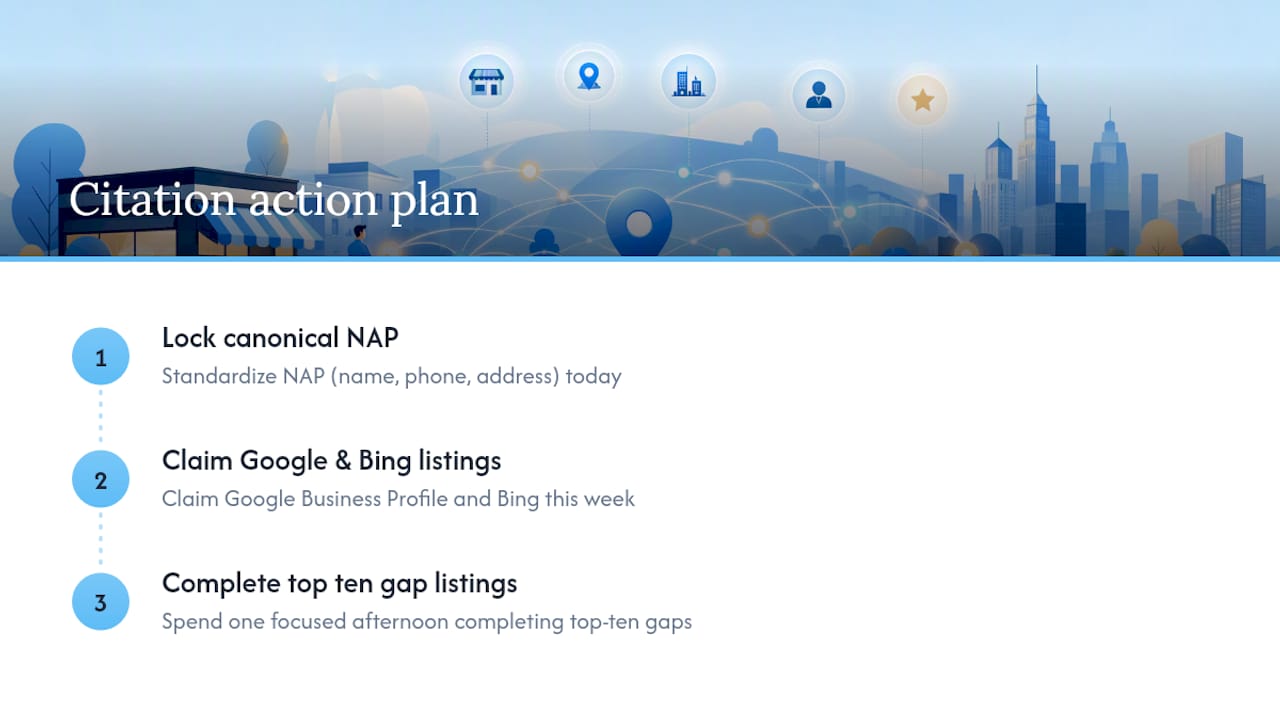
If you have thirty days and limited time, do three things: lock your canonical NAP today, claim your Google Business Profile and Bing Places this week, and spend one focused afternoon completing your top ten gap listings. That alone puts you ahead of most local competitors.
TTOY Digital’s managed citation service for small businesses
If the audit spreadsheet, aggregator submissions, and monthly monitoring sound like work you would rather hand off, TTOY Digital’s local SEO services cover the full citation build as a managed package. You get the audit delivered as a shared document, every login credential transferred on day one, aggregator submissions in week one, and Tier 1 claiming completed within a fortnight. Vertical and local directories follow a prioritised 90-day schedule based on your competitor gap analysis. Monthly monitoring keeps the top 25 listings accurate without you needing to check them yourself.
What makes it practical for small businesses specifically is that there is no lock-in on credentials and no opaque reporting. You see exactly what has been claimed, what is verified, and what is indexed. Enquiries generated by improved local visibility feed into TTOY Digital’s SmartFlowCRM, so you track every lead from first click to conversation. To get started, request a citation audit and we will tell you exactly where your listings stand within 48 hours.
Sources
- Local SEO citations - Moz
- How to build local citations & boost visibility - WordStream
- Citation link building guide - LinkForce
- Citation building for AI search - Lawrence Hitches
- How to build local citations - Flento
Audit tools worth trying: Moz Local, BrightLocal, and Whitespark all offer citation audit and monitoring features. For checking whether a specific listing is indexed, paste the listing URL into Google with a site: prefix.
FAQ
What does citation building mean?
Citation building is the process of creating and maintaining consistent online mentions of your business name, address, and phone number across directories, apps, and platforms to improve local search visibility.
What is a citation builder?
A citation builder is a tool or service that automates the submission of your business details to multiple directories; examples include Moz Local, BrightLocal, and Whitespark, which also monitor existing listings for inconsistencies.
Are citations good or bad for SEO?
Accurate, consistent citations on authoritative platforms are a positive local ranking signal. Inconsistent or duplicate citations actively harm rankings by confusing search engines about your business’s location and identity.
What does BrightLocal do?
BrightLocal is a local SEO platform that audits existing citations, tracks Local Pack rankings, monitors online reviews, and manages citation submissions across multiple directories from a single dashboard.
Can TTOY Digital manage my citations for me?
Yes. TTOY Digital’s local SEO service covers the full citation workflow: audit, aggregator submissions, Tier 1 claiming, vertical directory builds, and monthly monitoring, with full credential transfer to the client from day one.
Recommended
- How Search Engine Optimisation (SEO) works for small businesses | TTOY Digital
- Blogging for Business Growth | TTOY Digital
- Master Keyword Research to Boost Your Business Success | TTOY Digital
- Content strategy for small businesses: how to create content your audience will actually engage with | TTOY Digital