
The best web design agency for your business is the one that can prove it delivers business outcomes, not just attractive pages, backed by a documented process you can follow from kickoff to launch. If a proposal doesn’t mention measurable results or how the work actually gets done, that’s your first answer. This week, book one discovery call, and if you’re still unsure after it, ask for a small paid discovery project before signing anything bigger.
- Agencies that provide measurable results and a documented process are more likely to deliver successful websites tailored to your business goals.
- Live-site performance checks and outcome-driven case studies outweigh portfolio screenshots in evaluating an agency’s true effectiveness.
- A mature agency process includes clear stages from discovery to monitoring, with named contacts, fixed scope, and measurable success metrics built in from the start.
- Asking specific questions about past projects, ongoing support, and how they handle post-launch changes helps identify truly process-mature agencies.
- A small business website’s cost depends on complexity, with clear proposals and scope being more important than overall budget alone.
Table of Contents
- How do you choose a web design agency that fits your business?
- How do you evaluate a web design portfolio properly?
- What does a mature agency process actually look like?
- What questions should you ask on a discovery call?
- What red flags and contract terms should you watch for?
- What should a small-business website actually cost?
- How do you compare proposals and make a final decision?
- What a small business actually needs from an agency partnership
- Our take: the rubric matters more than the pitch
- How TTOY Digital can help you build with confidence
- Sources
- FAQ
How do you choose a web design agency that fits your business?
Most small business owners judge agencies on the wrong thing first: how nice the portfolio looks. Looks matter less than you’d think. What actually predicts whether a project succeeds is whether the agency understands your customers and shows outcome-focused case studies rather than only pretty screenshots.
Here’s the order we’d rank the criteria that genuinely separate good agencies from average ones:
- Business alignment first, aesthetics second. Ask how the agency plans to hit your goals, whether that’s bookings, enquiries, or online sales, before you ask about colour palettes.
- A documented process. Discovery, strategy, design, development, launch, and monitoring should each have a name and a deliverable, not a vague “we’ll sort it as we go.”
- Evidence over promises. Case studies with a problem stated, an approach explained, and a result measured. Client references you can actually ring.
- Technical depth. CMS choice, third-party integrations, page speed, and accessibility standards should come up unprompted.
- SEO and conversion thinking baked in, not bolted on after launch, since a fast, beautiful site that nobody finds on Google solves nothing.
- Named delivery contacts, not a rotating cast of freelancers you’ve never met.
- Transparent pricing and stated post-launch support, so you know what happens the day after go-live.
Pro Tip: Ask every agency you shortlist the same question: “What did you change on your last three projects after launch, based on real user data?” Agencies with process maturity always have an answer. The ones without one usually go quiet.
How do you evaluate a web design portfolio properly?
A portfolio full of screenshots tells you almost nothing. What tells you something is how the sites actually perform once you leave the agency’s own pitch deck.
- Visit the live sites yourself. Load them on your phone. Check how fast they open, whether menus work with a thumb, and whether anything looks broken on a smaller screen.
- Read the case studies properly. A strong one states the client’s problem, what the agency actually did about it, and a measurable result, ideally a conversion rate or lead volume shift, not just “the client loved it.”
- Check how recent and varied the work is. A stack of template sites from three years ago tells you the agency hasn’t kept pace with anything, including Google’s own standards.
- Ask for two or three references and actually call them. Ask what went wrong during the project, not just what went right; every project hits a snag somewhere, and how the agency handled it tells you more than the finished site does.
Guides on evaluating web design agency reviews consistently make the same point: live-performance checks beat portfolio screenshots because a screenshot can’t show you load time, mobile behaviour, or whether the client actually got more enquiries.
What does a mature agency process actually look like?
This is the part that separates agencies that talk a good game from ones that deliver. A serious process usually runs through seven stages, each with its own output:
- Discovery, where the agency asks about your customers, competitors, and goals, not just your colour preferences.
- Strategy, turning that discovery into a sitemap, content plan, and success metrics.
- Design, producing wireframes and visual mockups you sign off before a single line of code gets written.
- Development, building the site against agreed specs.
- QA, testing across devices and browsers before anything goes live.
- Launch, with a checklist covering redirects, tracking, and backups.
- Monitoring, reviewing performance data in the weeks after go-live and adjusting.
A short paid discovery phase, rather than a free “sales call disguised as strategy,” is worth paying for. It reveals how an agency actually communicates and thinks before you commit to a five-figure contract, and it costs a fraction of what a full rebuild does if the fit turns out wrong.
Revisions and scope changes should be written down before they happen, not negotiated mid-project. Ask how many rounds of design feedback are included and what happens if you want changes outside that scope.
Pro Tip: Before signing off on handover, insist on full CMS training, a documentation pack, and a working backup schedule. An agency that can’t hand these over cleanly usually can’t support you properly either.
What questions should you ask on a discovery call?
A discovery call is your best chance to separate agencies that talk process from ones that live it. Orbit Media’s research into agency interview questions backs up a short, pointed list rather than a long checklist nobody actually answers properly.
- “Walk me through your last project from kickoff to launch.” Vague answers here usually mean a vague process.
- “Who exactly will work on my project, and will I have a named contact?” If the answer dodges names, that’s worth noting.
- “How do you measure success after launch?” Listen for actual metrics, not “we’ll keep an eye on it.”
- “What happens if I want changes after the site goes live?” This reveals their support model before you’ve paid a penny.
- “Can you show me a project where something went wrong, and how you fixed it?” Nobody’s record is perfect; how they answer this matters more than the answer itself.
Follow up on every answer by asking for a specific example and a rough timeline. Vague timelines, no named team members, and “we’ll figure it out later” are the three phrases that should make you pause.
What red flags and contract terms should you watch for?
Some warning signs show up before you’ve even had a proposal. Guarantees of a first-page Google ranking, no written contract, or pricing that “depends” without a clear reason are all worth walking away from.
- Guaranteed rankings or traffic numbers, since nobody controls Google’s algorithm that precisely.
- No written scope, timeline, or ownership terms.
- Hidden fees that surface after the deposit clears.
- Reluctance to name past clients you can contact.
Your contract should spell out scope, timeline, revision limits, who owns the final code and content, and an exit clause if things go wrong. Validate any big claim, awards, client names, results, before you sign, by checking them independently rather than taking the pitch at face value.
What should a small-business website actually cost?
Budgets vary enormously depending on complexity, and agency guides covering typical pricing and timelines tend to describe wide bands rather than fixed rules, because a five-page brochure site and a booking-integrated site with a CRM connection aren’t remotely the same job.
- Simple brochure sites sit at the lower end, with shorter timelines when content and images are ready upfront.
- Sites with integrations (booking systems, e-commerce, CRM connections) push both price and timeline up.
- Your own responsiveness to feedback requests moves delivery dates more than almost anything else; slow content approval is the single biggest cause of delayed launches.
For where to put your money, discovery and SEO groundwork tend to pay back faster than a slightly fancier layout. Reviewing conversion rate benchmarks before you brief an agency gives you a realistic target to hold them to, rather than guessing what “good” looks like once the site’s live.
How do you compare proposals and make a final decision?
Once you’ve got two or three proposals in hand, score them the same way rather than going on gut feel. A simple weighted rubric keeps the comparison honest:
- Relevance to your business (30%): have they worked with businesses like yours, or shown they understand your customers?
- Process maturity (20%): is discovery, design, and QA clearly mapped out?
- Team and named contacts (15%): do you know who’s actually doing the work?
- Timeline realism (15%): does the schedule account for your own review time?
- Price transparency (10%): are there fixed costs and clearly listed exclusions?
- Communication during the sales process (10%): were they responsive and clear before you’d even paid them?
Run all your discovery calls in the same week if possible, and score each one straight after while it’s fresh. If two agencies tie, a small paid discovery project is a fair tie-breaker; it shows you real work, not just another pitch. Before signing anything, do one last check: read the contract fully and confirm every verbal promise appears in writing.
What a small business actually needs from an agency partnership
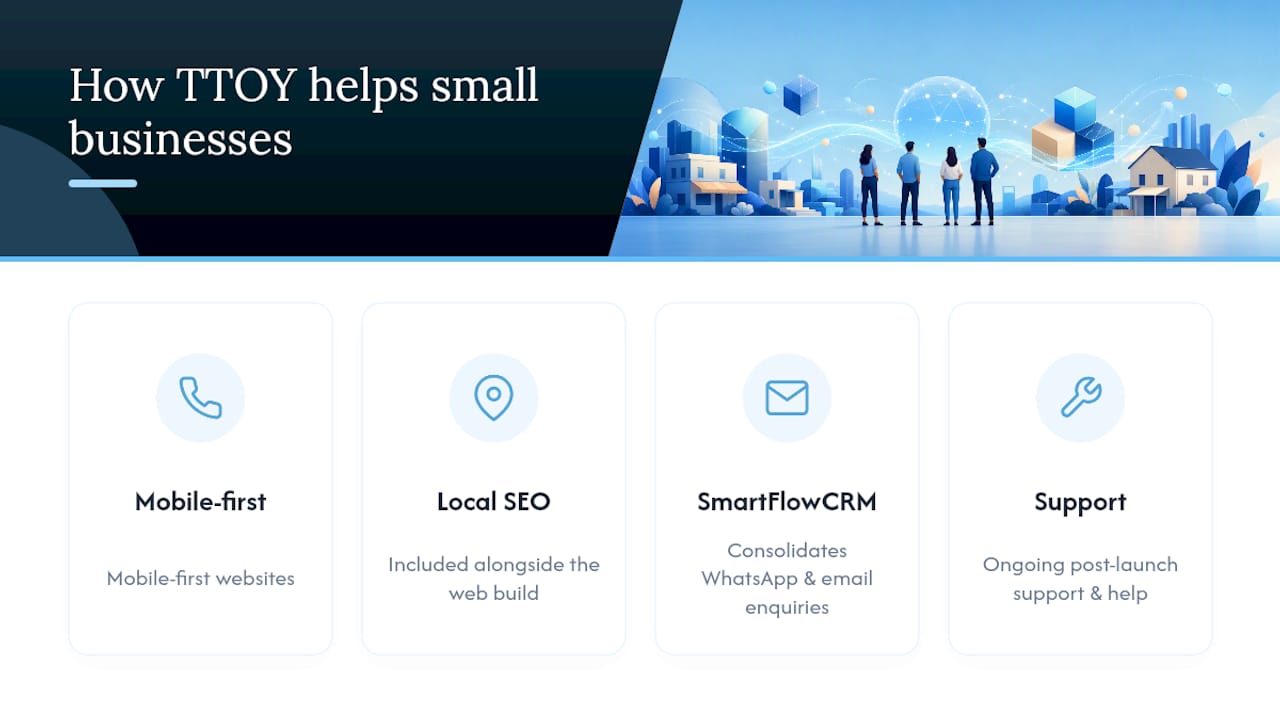
Choosing an agency isn’t really about finding the “best” one in the abstract. It’s about finding one whose process matches how your business actually operates, and whose past results look like the kind of result you want. TTOY Digital’s own approach centres on mobile-first builds paired with local SEO and lead management through SmartFlowCRM, built specifically around how small businesses actually run day to day rather than enterprise workflows repackaged for a smaller invoice.
Whichever agency you shortlist, hold them to the same rubric outlined above: proof of outcomes, a process you can follow, and support that doesn’t vanish the day the invoice is paid.
Our take: the rubric matters more than the pitch
Most advice on choosing an agency defaults to generic checklists, chemistry, communication, “gut feel.” None of that is wrong exactly, but it dodges the harder question: can this agency prove it moves the needle for a business your size? Small businesses don’t have the budget to learn that lesson the expensive way, twice.
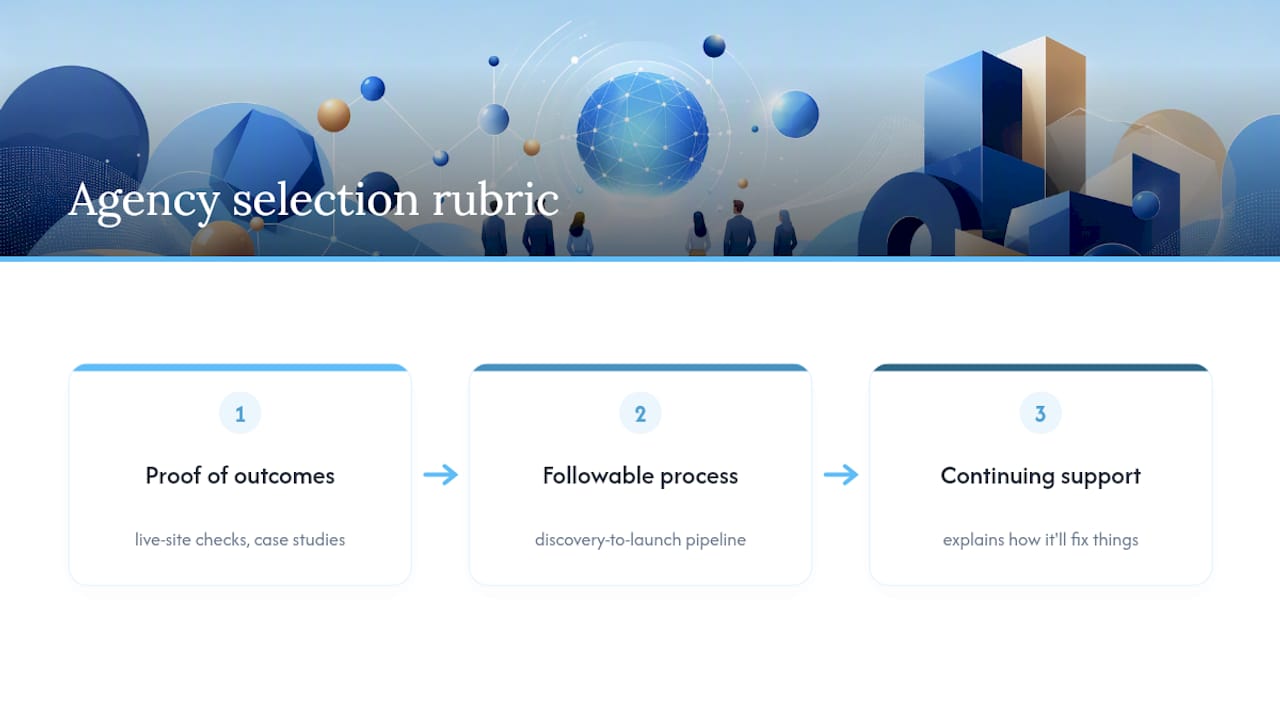
Where conventional advice really falls down is treating a slick portfolio as a proxy for competence. A portfolio shows design taste. It rarely shows whether the site actually loaded fast, converted visitors, or got found on Google six months later. That’s precisely why live-site checks and outcome-based case studies deserve more weight than most buyers give them.
If you take one thing from this article, prioritise process over polish. Ask to see the discovery-to-launch pipeline before you ask to see the mockups. An agency that can’t explain how it works probably can’t explain how it’ll fix things when something inevitably goes wrong, and something always does.
— Chris
How TTOY Digital can help you build with confidence
TTOY Digital works specifically with small businesses, not as a smaller version of an enterprise agency, but as a partner built around what small teams actually need: mobile-first websites, local SEO that gets you found in your own area, and SmartFlowCRM to keep enquiries from WhatsApp and email landing in one manageable place instead of three scattered inboxes. We also offer ongoing support after launch, so the site doesn’t quietly go stale six months in.
If your business needs visibility in a specific area, our local SEO services sit alongside the web build rather than as a separate project. TTOY Digital tends to fit best if you want a single point of contact who understands small-business budgets and timelines rather than a large account team. Book a discovery call through our web design services page and put us through the same rubric covered here; we’d rather you test us properly than take our word for it.
Sources
For deeper reading on agency selection, see Forbes on outcome-focused case studies, Orbit Media’s interview questions, and why measuring SEO performance matters once your site is live.
- How To Choose A Web Design Company That Understands Your Customers
- How to choose a web design agency, 2M Web Studio
- How to Choose a Web Designer: 20 Questions to Ask Before Hiring a Web Design Company, Orbit Media
FAQ
How do I choose the right web design agency for a small business?
Prioritise agencies that show outcome-based case studies, explain a documented process from discovery to launch, and offer clear post-launch support rather than disappearing after go-live.
What questions should I ask before hiring a web design agency?
Ask about their process from kickoff to launch, who will work on your project by name, how they measure success, and what happens if you need changes after launch.
Is a freelancer or an agency better for small business web design?
Freelancers can suit very small, simple projects, but agencies typically offer more resilience, a documented process, and dedicated support if a team member is unavailable, which matters more as your site grows in complexity.
How much should a small business website cost?
Costs vary by complexity, with simple brochure sites at the lower end and sites needing integrations like booking systems or CRM connections costing more; ask each agency for a clear breakdown rather than a single flat number.
What is a paid discovery phase and is it worth it?
A paid discovery phase is a short, focused engagement where an agency maps your goals and approach before a full project begins, and it’s a low-cost way to test their process and communication before signing a larger contract.
Recommended
- What does a good small business website look like?
- Bespoke Websites: Why every small business should have one.
- Website design cost UK: a 2026 pricing guide
- Unlock Your Brand Potential: Web Design Secrets
Related reading: Website design cost UK: a 2026 pricing guide · Core web vitals: a practical guide