I’ve been tracking something unsettling over the past few months.
We use audit software at TTOY Digital to monitor how businesses appear in AI-powered search results. The data shows a pattern most small business owners don’t know is happening.
Their businesses are disappearing.
Not from traditional Google search. Not from their local area. From the places where more and more people are looking for services: ChatGPT, Perplexity, and other AI assistants.
Half of consumers now seek out AI-powered search engines, with a majority saying it’s their top digital source for making buying decisions. This isn’t future thinking. It’s happening now.
The Plumber Who Became a Bathroom Fitter Overnight
Let me show you what this looks like in practice.
I’ve got a client in Derbyshire. He’s a plumber who’s been ranking well for “emergency plumber Alfreton” in traditional search for years. His business is built on emergency callouts and boiler repairs. That’s his bread and butter.
When we tested how he appeared in ChatGPT and Perplexity, something strange happened.
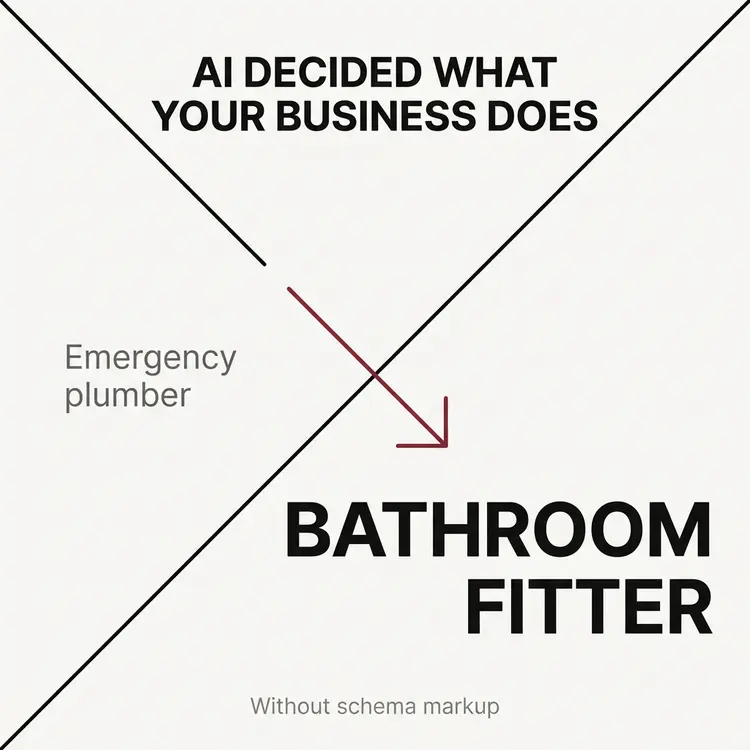
He wasn’t showing up for emergency plumbing at all. Instead, the AI was surfacing him for “bathroom installations” which represents about 20% of his business.
The AI redefined what his business does.
It latched onto his gallery images and a few case studies about bathroom refits. It missed his core service is emergency callouts. Traditional Google figured this out from his rankings and backlinks. The AI looked at what was most clearly defined in his site structure.
This is the crisis most small businesses don’t see coming.
Why Your Website Is Speaking the Wrong Language
When I dug into this plumber’s website, the problem became clear.
There was no structured data telling the AI what services he prioritises. His homepage had a generic “plumbing services” heading, but nothing in the site architecture said “emergency callouts are our main thing.”
No schema markup for local business. No proper service categorisation. No FAQ schema about emergency situations.
The bathroom refit pages had better images and more detailed descriptions, so the AI grabbed onto those. The website treated everything equally, and the AI couldn’t distinguish between his core offering and his side services.
Here’s what makes this concerning: different AI platforms pull information from wildly different sources. Gemini favours brand-owned websites. Perplexity leans into industry-specific directories.
You show up for completely different services depending on which AI someone uses.
The Knowledge Gap Nobody Talks About
When I explained this to my plumber client, his reaction was typical.
He had no idea what I was talking about.
I wouldn’t expect him to understand structured data and schema markup. It’s not his bread and butter. It’s like me knowing how to fix a tap. I’d have no idea.
This knowledge gap exists across nearly every small business I work with. They’re focused on running their businesses, serving their customers, doing what they do best.
The way people find them is changing.
From what I’m seeing in our audit software, we’re not at the point where businesses are losing enquiries yet. But I reckon we’re 6-8 months away from this becoming a real problem.
The hype around AI is driving experimentation. People are testing these tools. Search engines are introducing their own AI technologies. ChatGPT now sends more referral traffic than Reddit and LinkedIn combined.
The shift is accelerating faster than most people know.
The Foundation Problem
I’ve been watching agencies jump on this trend, selling “AI-first SEO” packages and upselling businesses on AI optimisation.
Most of it is rubbish.
You don’t build a house by starting with the roof. The fundamentals haven’t changed. This is good website structure that should have been there all along.
When I look at the typical small business website that comes to me now, maybe 10-15% have proper foundations in place. Those are usually businesses that have invested in professional web development in the last couple of years.
The rest are still on websites built 5+ years ago with no schema markup, poor site architecture, no structured data whatsoever.
They’re not thinking about AI optimisation. They haven’t got the basics sorted. And now agencies are trying to sell them “AI-ready packages” when their site doesn’t have proper local business schema or service categorisation.
It’s like trying to sell someone a smart thermostat when their house doesn’t have central heating installed yet.
What AI Actually Needs From Your Website
The variability across different AI platforms matters less than you might think.
Each one has its own quirks. Each pulls information from different sources. ChatGPT might grab from your site whilst Perplexity pulls from industry directories or Reddit.
There’s a common foundation that works across the board.
We focus on proper structured data and schema markup that any AI reads, regardless of where it’s pulling information from. It’s about making sure the website itself speaks a language that all these systems understand.
Local business schema. Service-specific markup. FAQ schema. Proper site architecture that clearly defines what the business does and prioritises.
That way, whether ChatGPT is pulling from the site or Perplexity is grabbing it from somewhere else, the core information about the business is consistent and machine-readable.
We can’t optimise for every single AI platform’s quirks. But we can make sure the fundamental data structure is solid across the board.
The Gradual Disappearance
As AI platforms improve, I think businesses without proper foundations will just disappear from results.
People are learning how to prompt better. They’re using this technology to find what they want without sifting through hundreds of results.
There’s an upside here for businesses who get this right. The leads will be warmer because people will have done their research through AI before reaching out.
Research backs this up: visitors from AI platforms convert 4.4 times better than organic search visitors. ChatGPT traffic converts at 15.9% compared to Google’s 1.76%.
But that only works if you’re in the results to begin with.
For businesses who disappear, the wake-up call won’t be obvious. They won’t be able to pinpoint why their enquiries have dropped.
I think it’ll be more gradual. The competition will be doing it better. They might hop onto ChatGPT themselves and ask a question. When they don’t show up, they’ll start to learn.
By then, they’re already behind.
The Conversation We’re Having Now
We’re not pushing the AI panic button with clients. That feels disingenuous.
Instead, we’re talking about it as part of the regular site audits and quarterly reviews we do anyway. We show them the audit software data. We let them see where they’re appearing in different search methods.
We frame it as: here’s what we need to tidy up to make sure you’re visible everywhere people are looking.
It’s about getting the foundations right now whilst we’ve got time, rather than waiting until they’re scrambling because enquiries have dropped.
Most of our clients trust us to get on with it. That’s the whole point of the done-for-you model. They don’t need to understand schema markup any more than I need to understand how to fix a boiler.
We just explain it’s like making sure their shopfront is visible from every angle, not just the high street.
Why This Matters More Than Previous SEO Shifts
I’ve been doing this since 2020. I’ve seen SEO trends come and go.
This feels different.
Traditional SEO was about ranking pages. AI search is about understanding entities and trust signals. The shift from “what does this page say” to “what does this business do” changes everything.
Research shows many small and mid-sized businesses are reporting steady traffic declines despite maintaining consistent content output. The issue isn’t poor content quality. It’s structural ambiguity.
Search engines struggle to extract business information without proper schema markup.
Over 45 million web domains now mark up their pages with Schema.org objects. From what I’m seeing, only 10-15% of small businesses have these foundations in place.
The structured data divide between enterprise websites and typical SME sites has never mattered more.
The Window Is Closing
In the UK, AI Overviews now appear in 42% of searches. When they do appear, they reduce website clicks by 34.5%.
ChatGPT had 1.8 billion UK visits in the first eight months of 2025, up from 368 million in the same period of 2024. That’s a nearly 400% increase in less than a year.
24 million people in the UK used AI tools in January 2026 alone, with 1.5 million new users added in just the last three months.
The timeline I’m seeing in our data suggests 6-8 months before this starts affecting enquiries for businesses without proper foundations.
That’s not long.
But here’s what I want you to understand: this isn’t about panic. It’s not about expensive “AI-ready” packages or complete website overhauls.
It’s about getting the basics right.
Proper schema markup. Clear site architecture. Service categorisation that tells AI systems what you do. Local business structured data that helps AI understand who you serve and where.
These are things that should have been there all along. The AI shift makes them essential instead of optional.
What Happens Next
Small businesses have always been more agile than large enterprises.
You can make changes faster. You can adapt quicker. You don’t need board approval or lengthy procurement processes.
The businesses that act now, whilst there’s still time to build proper foundations, will be the ones who benefit from higher-quality leads and better conversion rates.
The ones who wait will find themselves gradually disappearing from results they don’t even know exist yet.
I’m not here to sell you panic. I’m here to show you what I’m seeing in the data, what’s happening with real businesses in Derbyshire and beyond, and what we’re doing to help our clients stay visible.
Because in 6-8 months, when someone in Alfreton asks ChatGPT for an emergency plumber, I want my client to show up for what he actually does.
Not as a bathroom fitter.
As an emergency plumber.
That’s what proper foundations look like in practice.